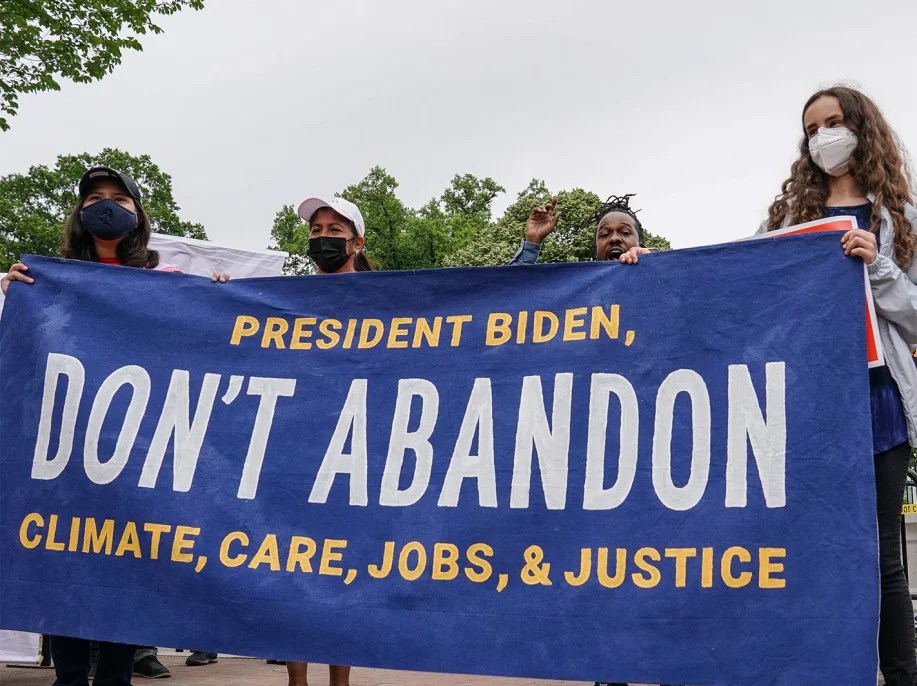
Have you written a note to President Biden recently? I try to do it regularly. Most often it is a letter of thanks and support. Because we all need a pat on the back, don’t we? Today, my letter was a pat on the back and a request – no, a plea. BTW, writing to the White House is easy. Here is the link: https://www.whitehouse.gov/contact/
Dear President Biden,
Based on what you have accomplished in your first two years in office, you will be viewed as one of our most important and consequential Presidents. You have literally had to rebuild the government and our international relationships. Kudos. You have my deepest admiration. You are the President we needed in 2020. You are a President that still makes us proud.
But PLEASE do not run for re-election. While I believe that your judgement is clear and that your experience is epic, you should not run again. Not because you couldn’t perform well at your age. But because two whole generations of voters may not support you. Gen Y and Gen Z may just stay at home. Please do the research.
If younger Democrats and Independents don’t turn out to vote, we lose battles up and down the ticket. We lose at the Federal, State and Local levels. If Democrats don’t prevail in 2024, the planet is doomed. Democracy will collapse.
This message is not about your qualifications or your sincere efforts at making America a better place for all of us. This is a reality check. This is a message about our relatability from one generation to another. Read the surveys your advisors may be afraid to show you.
Please don’t let your ego overtake what is best for the country. We can’t rely on boomers (like me) to carry us forward. We need the youth vote.
It is time to pass the torch.
Thank you for all that you have done and will do. But the Democratic bench is deep. In your heart, you know this isn’t about anything other than the fact that time passes and younger people need to take the reins. If they aren’t given the chance, the GQP nutcases will prevail. The nation and the planet can’t afford such a thing.
A Traitor who is still a hero for American Traitors
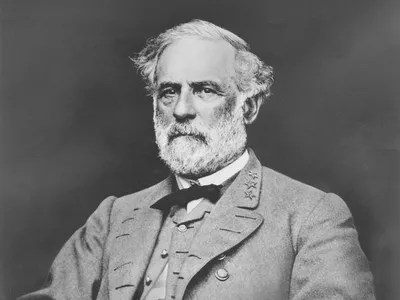
Today is Martin Luther King’s birthday. And yet. This is America in 2023 and the “old South” lives on. You can be a fan of Robert E. Lee as a military tactical genius. But if you can’t call him a traitor to this nation, you need to question your own loyalty to the US of A. You can’t fly the Confederate battle flag and the American flag at the same time. If try, you are a bigoted and confused idiot.
Below is an article from Axios that explains that several states still celebrate THE CONFEDERACY and the TRAITORS who led a rebellion against the United States of America. And we wonder where “White Supremacy” and “Christian Nationalism” comes from?
“Confederate Memorial Day”? WTF?
Could we possibly stop dancing around…politely trying to be respectful of a culture that enslaved, tortured and lynched thousands of humans? The South still honors and celebrates brutality and inhumanity. Why do we ignore it? Who are these people? They are not real Christians. What are they? Find your own definitions. I’ll go with monsters. The “old South” is right up there with the Third Reich. In fact, Hitler derived some of his ideas from the American South’s view of African Americans. Links below.
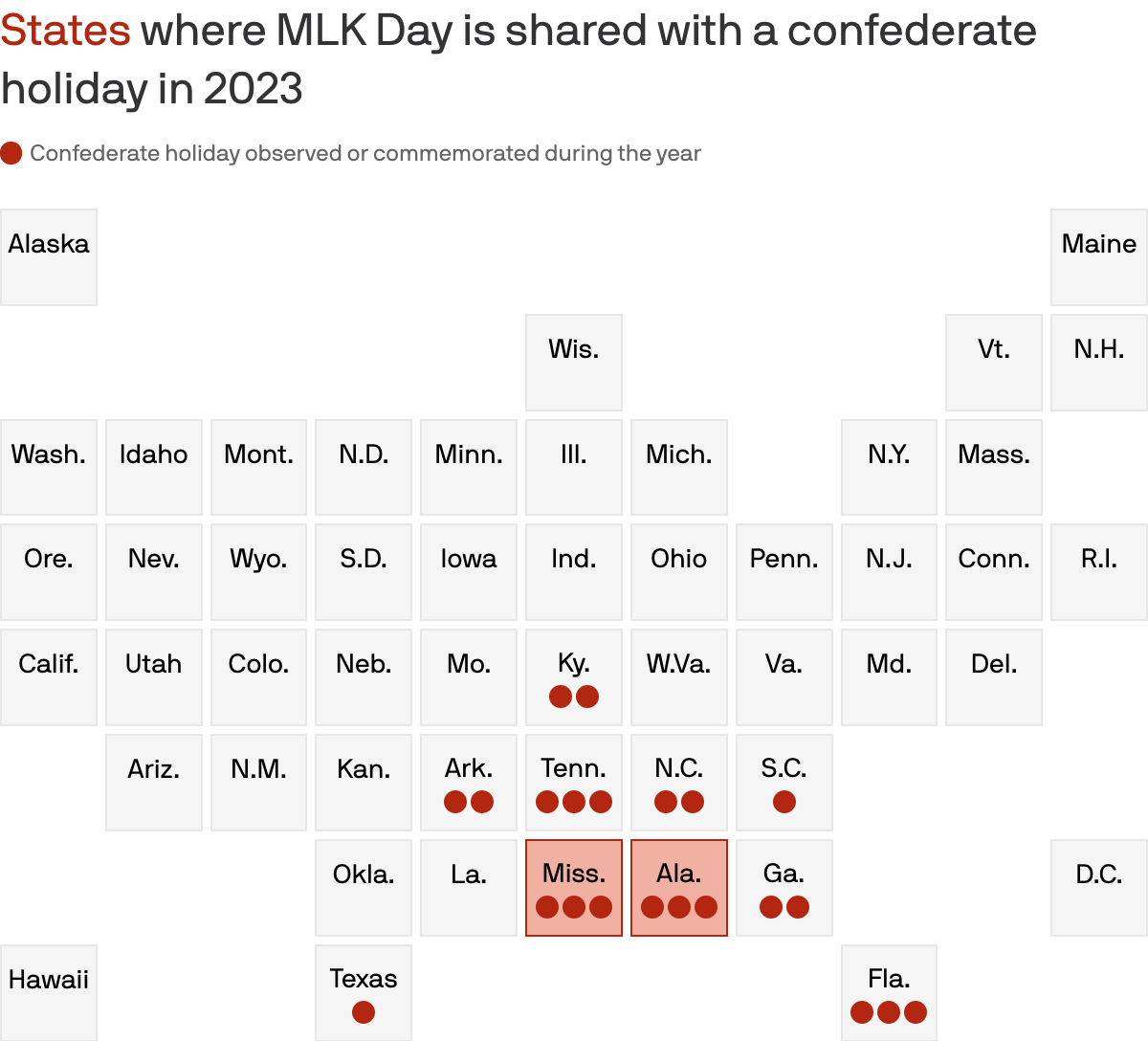
Mapped: 10 states celebrate both MLK Day, Confederate holidays
Confederate holidays include Robert E. Lee’s birthday, Confederate Memorial Day, Confederate Heroes Day (Texas), Nathan Bedford Forrest Day (Tennessee), Jefferson Davis’ birthday. Data: State government calendars, Axios research. Cartogram: Shoshana Gordon and Jacque Schrag/Axios Visuals
Ten states — all in the South — observe Martin Luther King Jr. Day + at least one Confederate holiday, Axios’ Shoshana Gordon, Jacque Schrag and Russell Contreras report.
Why it matters: All U.S. states honor King — a federal holiday. But the number of states also honoring the Confederacy highlights the country’s struggle to reconcile its racial past.
Today, Alabama and Mississippi celebrate King-Lee Day — honoring both King and Robert E. Lee, the Confederate general and slaveholder.
Arkansas, Georgia, Florida, Kentucky, North Carolina, South Carolina, Tennessee and Texas all have at least one day commemorating the Confederacy on other days of the year.
Mississippi and Alabamaeach celebrate a total of three Confederate holidays every year — Robert E. Lee Day, Confederate Memorial Day and Jefferson Davis’ Birthday — all paid holidays for state employees.
In 2000, when South Carolina became one of the last states to honor MLK with a state holiday, the legislature also voted to create Confederate Memorial Day.
And there it ison the official 2023 state calendar — May 10.
How important is it to you that American kids be the best educated in the world? Or is it OK that 15 countries rate higher in education than the US – including Russia? Is it OK in your mind that a tiny subset of society is holding $100 trillion in assets and our teachers are paid crappy wages? They are paid poorly and asked to perform in ways they never anticipated. Mass shooter drills. Pandemic remote learning. Political interference by radical parents. Why would anyone want to work in teaching under these circumstances? Especially when they can achieve much higher wages in other sectors of employment.
There is an old saying that “those who can, do. Those who can’t, teach.” The current funding model for education in our country fosters that dismissive and insulting attitude towards what we should consider the most important profession in society. The way we under fund education says that we don’t really care about the future. We don’t really care about how future generations will fare. It is selfish and if you have any hope for an America that could lead the world, it is stupid.
Funding public education through property taxes guarantees unequal education. It fuels segregated neighborhoods. It separates us as a society from each other. Zip code funding of schools needs to go. The kid in a rural or inner city school should have the same financial resources dedicated to his education as Richie Rich in the suburbs.
Below is an article about how dire the situation is. And here is a link that bypasses the NYTimes paywall so you can read the original. Thomas B. Edsall on education in the US
There’s a Reason There Aren’t Enough Teachers in America. Many Reasons, Actually.
Mr. Edsall contributes a weekly column from Washington, D.C., on politics, demographics and inequality.
Here are just a few of the longstanding problems plaguing American education: a generalized decline in literacy; the faltering international performance of American students; an inability to recruit enough qualified college graduates into the teaching profession; a lack of trained and able substitutes to fill teacher shortages; unequal access to educational resources; inadequate funding for schools; stagnant compensation for teachers; heavier workloads; declining prestige; and deteriorating faculty morale.
Nine-year-old students earlier this year revealed “the largest average score decline in reading since 1990, and the first ever score decline in mathematics,” according to the National Center for Education Statistics. In the latest comparison of fourth grade reading ability, the United States ranked below 15 countries, including Russia, Ireland, Poland and Bulgaria.
Doris Santoro, a professor of education at Bowdoin, wrote by email in response to my query regarding the morale of public school teachers:
Teachers are not only burnt out and undercompensated, they are also demoralized. They are being asked to do things in the name of teaching that they believe are mis-educational and harmful to students and the profession. What made this work good for them is no longer accessible. That is why we are hearing so many refrains of “I’m not leaving the profession, my profession left me.”
systematically examined news reports, department of education data, and publicly available information on teacher shortages for every state in the U.S. We find there are at least 36,000 vacant positions along with at least 163,000 positions being held by underqualified teachers, both of which are conservative estimates of the extent of teacher shortages nationally.
In an email, Nguyen argued, “The current problem of teacher shortages (I would further break this down into vacancy and under-qualification) is higher than normal.” The data, Nguyen continued, “indicate that shortages are worsening over time, particularly over the last few years. We do see that southern states (e.g., Mississippi, Alabama, Georgia and Florida) have very high vacancies and high vacancy rates.”
He pointed out that “the cultural war issues have been prominent in some of these states (e.g., Florida).”
I asked Josh Bleiberg, a professor of education at the University of Pittsburgh, about trends in teacher certification. He emailed back:
The number of qualified teachers is declining for the whole country and the vast majority of states. The number of certified teachers only increased in the District of Columbia, Massachusetts, North Dakota, and Washington. Those increases were relatively small and likely didn’t keep up with enrollment increases.
These declines in the numbers of qualified teachers take place in an environment of stagnant or declining economic incentives, he wrote:
Wages are essentially unchanged from 2000 to 2020 after adjusting for inflation. Teachers have about the same number of students. But, teacher accountability reforms have increased the demands on their positions. The pandemic was very difficult for teachers. Their self-reported level of stress was about as twice as high during the pandemic compared to other working adults. Teachers had to worry both about their personal safety and deal with teaching/caring for students who are grieving lost family members.
According to the National Center for Education Statistics, the number of students graduating from college with bachelor’s degrees in education fell from 176,307 in 1970-71 to 104,008 in 2010-11 to 85,058 in 2019-20.
In a study of teachers’ salaries, Sylvia Allegretto, a research associate at the Economic Policy Institute, found a growing gap between the pay of all college graduates and teacher salaries from 1979 to 2021, with a sharp increase in the differential since 2010. In 1979, the average teacher weekly salary (in 2021 dollars) was $1,052, 22.9 percent less than other college graduates’, at $1,364. By 2010, teachers made $1,352 and other graduates made $1,811. By 2021, teachers made $1,348, 32.9 percent less than what other graduates made, at $2,009.
These gaps play a significant role in determining the quality of teachers, according to a study by Eric A. Hanushek of Stanford; Marc Piopiunik, a senior researcher at the CESifo Network; and Simon Wiederhold, a professor at the Catholic University of Eichstätt-Ingolstadt, “The Value of Smarter Teachers: International Evidence on Teacher Cognitive Skills and Student Performance.”
“We find,” they write, “that teachers’ cognitive skills differ widely among nations — and that these differences matter greatly for students’ success in school. An increase of one standard deviation in teacher cognitive skills is associated with an increase of 10 to 15 percent of a standard deviation in student performance.” In addition, they find “that teachers have lower cognitive skills, on average, in countries with greater nonteaching job opportunities for women in high-skill occupations and where teaching pays relatively less than other professions. These findings have clear implications for policy debates here in the U.S., where teachers earn some 20 percent less than comparable college graduates.”
Using data for 33 countries collected by the O.E.C.D.’s Program for the International Assessment of Adult Competencies, the scholars found that the cognitive skills of teachers in the United States fell in the middle ranks:
Teachers in the United States perform worse than the average teacher sample-wide in numeracy, with a median score of 284 points out of a possible 500, compared to the sample-wide average of 292 points. In literacy, they perform slightly better than average, with a median score of 301 points compared to the sample-wide average of 295 points.
Raising teacher skill levels can significantly improve student performance, they argue:
Increasing teacher numeracy skills by one standard deviation increases student performance by nearly 15 percent of a standard deviation on the PISA math test. Our estimate of the effect of increasing teacher literacy skills on students’ reading performance is slightly smaller, at 10 percent of a standard deviation.
In addition, “the impact of teacher skills is somewhat larger for girls than for boys and for low-income students compared to wealthier students, particularly in reading
How, then, to raise teacher skill level in the United States? Hanushek and his two colleagues have a simple answer: raise teacher pay to make it as attractive to college graduates as high-skill jobs in other fields.
They have one caveat:
While making it clear that a more skilled teaching force is generally found in countries with higher relative salaries, policymakers will need to do more than raise teacher pay across the board to ensure positive results. They must ensure that higher salaries go to more effective teachers.
The teaching of disputed subjects in schools has compounded many of the difficulties in American education. “Walking a Fine Line — Educators’ Views on Politicized Topics in Schooling,” a RAND report by Ashley Woo and eight fellow researchers, published earlier this year, was based on surveys conducted in January and February 2022 of 2,360 K-12 teachers and 1,540 principals. The researchers found that controversies over critical race theory, sex education and transgender issues — aggravated by divisive debates over responses to Covid and its aftermath — are inflicting a heavy toll on teachers and principals.
“On top of the herculean task of carrying out the essential functions of their jobs,” they write, “educators increasingly find themselves in the position of addressing contentious, politicized issues in their schools as the United States has experienced increasing political polarization.”
Teachers and principals, they add, “have been pulled in multiple directions as they try to balance and reconcile not only their own beliefs on such matters but also the beliefs of others around them, including their leaders, fellow staff, students, and students’ family members.”
These conflicting pressures take place in a climate where “emotions in response to these issues have run high within communities, resulting in the harassment of educators, bans against literature depicting diverse characters, and calls for increased parental involvement in deciding academic content.”
The stress of dealing with all this is much more prevalent among educators than it is among workers in other fields, according to the study:
Forty-eight percent of principals and 40 percent of teachers reported that the intrusion of political issues and opinions in school leadership or teaching, respectively, was a job-related stressor. By comparison, only 16 percent of working adults indicated that the intrusion of political issues and opinions in their jobs was a source of job-related stress. This difference demonstrates the especially salient impact that politicized issues have had in schools compared with other workplaces.
The issue of systemic racism provides an example of the intellectual and moral cross-pressures on educators as teaching becomes increasingly politicized. Many conservative legislatures have restricted or prohibited teaching students that there is such a thing as systemic racism in the United States.
The RAND survey asked educators whether “they believed in the existence of systemic racism, which we defined as the notion that racism is embedded in systems and structures throughout society rather than present only in interpersonal interactions.”
The result?
Sixty percent of teachers and 65 percent of principals reported believing that systemic racism exists. Only about 20 percent of teachers and principals reported that they believe systemic racism does not exist, and the remainder were not sure. More teachers of color (69 percent) reported believing in the existence of systemic racism than White teachers (57 percent). We saw a similar trend among principals: 79 percent of principals of color reported their belief in the existence of systemic racism compared with 61 percent of White principals. Nearly all Black or African American principals (92 percent) and teachers (87 percent) reported believing that systemic racism exists.
White educators working in predominantly white school systems reported substantially more pressure to deal with politically divisive issues than educators of color and those working in mostly minority schools: “Forty-one percent of white teachers and 52 percent of white teachers and principals selected the intrusion of political issues and opinions into their professions as a job-related stressor, compared with 36 percent of teachers of color and principals of color.” In addition, they write, “Teachers (46 percent) and principals (58 percent) in schools with predominantly white students were significantly more likely than teachers (34 percent) and principals (36 percent) in schools with predominantly students of color to consider the intrusion of political issues and opinions as a job-related stressor.”
A 54 percent majority of teachers and principals said there “should not be legal limits on classroom conversations about racism, sexism, and other topics,” while 20 percent said there should be legislated constraint. There were significant racial differences on this issue: “62 percent of principals of color and 59 percent of teachers of color opposed such legal limits, compared with 51 percent of white principals and 52 percent of white teachers.”
Voters, in turn, are highly polarized on the teaching of issues impinging on race or ethnicity in public schools. The Education Next 2022 Survey asked, for example:
Some people think their local public schools place too little emphasis on slavery, racism and other challenges faced by Black people in the United States. Other people think their local public schools place too much emphasis on these topics. What is your view about your local public schools?
The responses of Democrats and Republicans were mirror opposites of each other. Among Democrats, 55 percent said too little emphasis was placed on slavery, racism and other challenges faced by Black people, and 8 percent said too much. Among Republicans, 51 said too much and 10 percent said too little.
Because of the lack of reliable national data, there is widespread disagreement among scholars of education over the scope and severity of the shortage of credentialed teachers, although there is more agreement that these problems are worse in low-income, high majority-minority school systems and in STEM and special education faculties.
A study based on a survey last summer of 682 public high school principals and on 32 follow-up interviews, conducted by the Institute for Democracy, Education and Access at U.C.L.A. and the Civic Engagement Research Group at the University of California-Riverside, “Educating for a Diverse Democracy: The Chilling Role of Political Conflict in Blue, Purple, and Red Communities,” found:
Public schools increasingly are targets of conservative political groups focusing on what they term “Critical Race Theory,” as well as issues of sexuality and gender identity. These political conflicts have created a broad chilling effect that has limited opportunities for students to practice respectful dialogue on controversial topics and made it harder to address rampant misinformation. The chilling effect also has led to marked declines in general support for teaching about race, racism, and racial and ethnic diversity.
These political conflicts, the authors wrote,
have made the already hard work of public education more difficult, undermining school management, negatively impacting staff, and heightening student stress and anxiety. Several principals shared that they were reconsidering their own roles in public education in light of the rage at teachers and rage at administrators’ playing out in their communities.
Since 2010 there has been a cumulative decline in four key measures shaping the attractiveness of the teaching profession.
In a November 2022 paper, “The Rise and Fall of the Teaching Profession: Prestige, Interest, Preparation, and Satisfaction Over the Last Half Century,” Matthew Kraft of Brown University and Melissa Arnold Lyon of the University at Albany, State University of New York tracked trends on “four interrelated constructs: professional prestige, interest among students, preparation for entry, and job satisfaction” for 50 years, from the 1970s to the present and found
a consistent and dynamic pattern across every measure: a rapid decline in the 1970s, a swift rise in the 1980s, relative stability for two decades, and a sustained drop beginning around 2010. The current state of the teaching profession is at or near its lowest levels in 50 years.
The analysis by Kraft and Lyon poses a crucial issue for those concerned about the quality of teaching in public schools:
Growing dissatisfaction and burnout among teachers in the wake of the pandemic and new state laws restricting discourse on racism and sexuality in schools have set ablaze a long smoldering question: Who among the next generation of college graduates will choose to teach?
Some of the specifics in the Kraft-Lyon study:
Perceptions of teacher prestige have fallen between 20 percent and 47 percent in the last decade to be at or near the lowest levels recorded over the last half century. Interest in the teaching profession among high school seniors and college freshmen has fallen 50 percent since the 1990s, and 38 percent since 2010, reaching the lowest level in the last 50 years. The number of new entrants into the profession has fallen by roughly one third over the last decade, and the proportion of college graduates that go into teaching is at a 50-year low. Teachers’ job satisfaction is also at the lowest level in five decades, with the percent of teachers who feel the stress of their job is worth it dropping from 81 percent to 42 percent in the last 15 years.
The combination of these factors — declining prestige, lower pay than other professions that require a college education, increased workloads, and political and ideological pressures — is creating both intended and unintended consequences for teacher accountability reforms mandating tougher licensing rules, evaluations and skill testing.
We find that accountability reforms reduced the number of newly licensed teacher candidates and increased the likelihood of unfilled teaching positions, particularly in hard-to-staff schools. Evidence also suggests that reforms increased the quality of newly hired teachers by reducing the likelihood that new teachers attended unselective undergraduate institutions.
In addition, Kraft, Brunner, Dougherty and Schwegman write:
Evaluation reforms also appear to have reduced teacher satisfaction and autonomy. We find that evaluation reforms resulted in a 14.6 percentage point drop in the likelihood that teachers Strongly Agree that they are satisfied with being a teacher. We find a 5.7 percentage point decrease in the probability that new teachers Strongly Agree that they have control over the content and skills they teach and an 8.9 percentage point drop in the probability that new teachers Strongly Agree that they have control over their teaching techniques.
The authors’ conclusion provides little comfort:
Education policy over the past decade has focused considerable effort on improving human capital in schools through teacher accountability. These reforms, and the research upon which they drew, were based on strong assumptions about how accountability would affect who decided to become a teacher. Counter to most assumptions, our findings document how teacher accountability reduced the supply of new teacher candidates by, in part, decreasing perceived job security, satisfaction and autonomy.
The reforms, Kraft and colleagues continued, increased
the likelihood that schools could not fill vacant teaching positions. Even more concerning, effects on unfilled vacancies were concentrated in hard-to-staff schools that often serve larger populations of low-income students and students of color. We find that evaluation reforms increased the quality of newly hired novice teachers by reducing the number of teachers that graduated from the least selective institutions. We find no evidence that evaluation reforms served to attract teachers who attended the most selective undergraduate institutions.
In other words, the economic incentives, salary structure and work-life pressures characteristic of public education employment have created a climate in which contemporary education reforms have perverse and unintended consequences that can worsen rather than alleviate the problems facing school systems.
If so, to improve the overall quality of the nation’s more than three million public schoolteachers, reformers may want to give priority to paychecks, working conditions, teacher autonomy and punishing workloads before attempting to impose higher standards, tougher evaluations and less job security.
One of the most powerful and inspiring books I have ever read is “Mountains After Mountains” by Tracy Kidder. It is a profile of Dr. Paul Farmer who accomplished what many thought was impossible. He saved thousands of lives with little resources. He did it by respecting local cultures. He did it by creative persistence in the face of enormous obstacles. Paul Farmer died this year – hard at work at only 62. I cried when I read the news. Read the book. You may cry too. https://www.tracykidder.com/mountains-beyond-mountains.html
What follows is a recap from an opinion columnist at the NYTimes. It’s also a giving suggestion. After the article is a no paywall link to the original article published today. Consider reading the book. Consider giving to PIH. Consider giving the book which was first published 20 years ago. It is a timeless lesson in how someone can defy convention and make an enormous difference.
Shortly after Paul Farmer helped get Partners in Health off the ground in 1987, international global health groups were debating whether it was even possible to treat poor patients with multidrug-resistant tuberculosis, as its treatments were expensive and required patients to stick to complicated regimens. Indeed, even ordinary tuberculosis for which cheaper drugs and proven regimens existed kept killing poor people around the world.
Farmer, and the band of can-do mavericks who had assembled around P.I.H., had no patience for such excuses — or any excuses for denying care to poor people.
Their programs, based on providing high-quality care regardless of patients’ ability to pay and empowering them in their own treatment, were so successful that they upended global public health.
In his biography of Farmer, “Mountains Beyond Mountains,” from 2003, Tracy Kidder noted that even as tuberculosis killed more adults than any other disease in Haiti, not a single person had died of it since 1988 in the P.I.H. hospital that served a desperately poor rural area with a population of about 100,000 people. Protocols the group developed in Peru for successfully treating multidrug-resistant tuberculosis were adopted globally.
After learning about Farmer and P.I.H. from Kidder’s book, I’ve been donating to the organization ever since.
This year is particularly poignant, though. Farmer died in February.
According to Kidder, P.I.H. reduced newborn H.I.V. transmission from mothers to babies in the rural Haitian community it served to 4 percent, which he also noted was less than the rate in the United States at the time. Their clinic stopped outbreaks of drug-resistant typhoid with effective antibiotics and by cleaning up water supplies. It drastically reduced infant mortality. They achieved this despite a meager budget and with many patients traveling for hours, sometimes on foot or by donkey.
How? Farmer had a very straightforward philosophy: All sick people deserve high-quality treatment. Illness and poverty are intertwined. The proper response is to provide resources while working with people to empower them — thus Partners in Health.
The secret? Treat the whole person. With respect.
Poor patients needed more than drugs to get well, so Partners in Health provided them with food, too. They provided school fees to children. They installed systems to purify the water that caused so much disease. And they always trained and hired local staff, who would follow up with patients to identify and help remove obstacles to their treatment.
Farmer, a Harvard-educated physician, was also trained as a medical anthropologist. Kidder wrote that Farmer learned from local staff that more than three-quarters of Voodoo ceremonies were attempts to drive away illness. He saw little reason to argue with people about beliefs and faith; instead, he always focused on providing high-quality health care. Voodoo priests that he treated ended up as conveyor belts to the clinic, bringing their own ill parishioners to be treated. Farmer approached people with humility and respect, which they reciprocated.
Farmer’s own lapsed Catholicism was rejuvenated by his encounters with liberation theology, with its sharp criticism of inequality and injustice. He didn’t see theology as an obstacle to his mission. He’d say he had “faith” but also add: “I also have faith in penicillin, rifampin, isoniazid and the good absorption of the fluoroquinolones, in bench science, clinical trials, scientific progress, that H.I.V. is the cause of every case of AIDS, that the rich oppress the poor, that wealth is flowing in the wrong direction, that this will cause more epidemics and kill millions.”
Farmer was only 62 when he died, while training staff in a Rwandan hospital he helped establish. He had lived nonstop, treating patients around the world as well as fund-raising, cajoling, pleading and teaching.
Sociologists recognize a form of power called “charismatic authority” — Max Weber called it “the authority of the extraordinary and personal gift of grace.” Farmer certainly represented that. He inspired a generation of doctors, nurses, public health workers and advocates and ordinary people. He used the respect and awe he garnered to lobby global leaders and to help lead the charge to change how public health operates.
But what happens to a movement when its charismatic leader dies? In this case, the best option is what sociologists call “routinization of charisma” — things keep working because they become entrenched and institutionalized, not just because someone extraordinary wields enormous personal influence.
Since the early days, P.I.H. had already grown larger and more institutionalized, attracting millions in donations from individuals as well as foundations. They’ve expanded from Haiti and Peru to places like Rwanda, Sierra Leone, Lesotho and Navajo Nation. But they’re still small compared to the need. And their kind of work is even more crucial now, since the pandemic didn’t just cause suffering through Covid-19 — much basic health care has been interrupted around the world. As it always goes, the poorest, globally, will suffer the most from these disruptions, which will require an extensive effort to ameliorate.
Paul Farmer’s answer to “how does one scale this up” seemed to be simple: follow the basic principles of dignity, training and empowering local people and giving them resources. Money always matters.
Too often, the burning, basic question of lack of resources gets buried under debates about the effectiveness of various approaches and worries about being pragmatic or sensible. But as Farmer pointed out, many who advocate for “sensible” policies that ended up doing too little for the poor and sick “would never accept such a death sentence themselves” or their children.
Would I prefer a global tax policy that redistributed wealth to alleviate poverty and illness, rather than relying on N.G.O.s like P.I.H.? Yes. But we can’t just wait for an ideal resolution when desperate families need a clinic where they will be treated for free, perhaps provided food and school fees.
This year, I’m writing my check for P.I.H. not just because of their good work in some of the toughest places around the world but also with the hope that Paul Farmer’s legacy of providing treatment, respect and empowerment to all patients can endure and even thrive. When one donates online to P.I.H., there’s a box that asks if it’s in memory of someone. I’m going to write Paul Farmer there, and hope they get enough extra donations, maybe even for another clinic somewhere, because saving lives now is what matters.
This article is part of Times Opinion’s Giving Guide 2022. The author has no direct connection to the organizations mentioned. If you are interested in any organization mentioned in Times Opinion’s Giving Guide 2022, please go directly to its website. Neither the authors nor The Times will be able to address queries about the groups or facilitate donations.
The Times is committed to publishing a diversity of letters to the editor. We’d like to hear what you think about this or any of our articles. Here are some tips. And here’s our email: letters@nytimes.com.
Zeynep Tufekci (@zeynep) is a professor at Columbia University, the author of “Twitter and Tear Gas: The Power and Fragility of Networked Protest” and a New York Times Opinion columnist.
Below is a gifted link (skip the pay wall) to the original article:
Most of you who subscribe to this Substack letter, read Heather Cox Richardson’s “Letters from an American”. If not, don’t wait any longer. (See the link at the end.) Her understanding of history and how it applies to our current events is stunning and inspirational.
Below is an interview by John Wolfson for Boston College Magazine.
History’s First Draft
We sit down with Heather Cox Richardson, the BC history professor whose smash newsletter Letters from an American has made her one of the country’s leading public intellectuals.
By John Wolfson
Fall 2022
Three years ago, Heather Cox Richardson was in the middle of the kind of sparkling career that any academic would admire. The BC history professor had written a number of highly regarded books, was a regular contributor to respected publications such as the Washington Post, had cohosted an NPR podcast, and had amassed twenty thousand or so followers on Facebook who looked forward to her weekly essays about history, current events, and life itself.
Then, in 2019, something happened in Washington that would change the trajectory of Richardson’s career. The chair of the House Intelligence Committee sent a letter to the acting director of national intelligence demanding that, in accordance with the law, a whistleblower complaint be turned over to the committee. To Richardson, the letter marked the first time that a lawmaker had accused a member of the Trump administration of breaking the law. Recognizing the historical significance of the moment, Richardson dedicated one of her Facebook essays to it. Rather than assume her readers were already experts, however, she used her conversational writing style to provide context and help her audience understand the nuances of the issue. The response was astounding. So Richardson wrote again two days later. “The floodgates just opened,” she recalled. “And I’ve written every night since then.”
Those early essays formed the beginnings of Letters from an American, Richardson’s daily musings about the state of the nation. She continues to post her 1,200-word essays for free on Facebook, but hundreds of thousands of people also pay for subscriptions to them on the hit newsletter platform Substack, on which Richardson is one of the most successful authors. Her posts generate tens of thousands of comments. She was named one of USA Today’s 2022 women of the year. And she was invited in February to travel to the White House to interview President Biden.
We sat down with Richardson to discuss her sudden—and quite unexpected—rise to media stardom, the state of the country, and how the job of historians will change in the future.
There’s much more to this conversation. To listen to the entire Boston College Magazine podcast, click here.
How did Letters from an American get its start? I had a Facebook page of about twenty-two thousand people in 2019, and I posted an essay on it about once a week—sometimes about history, sometimes about life, whatever, just because I like to write. And I had not written in 2019 since July 18 and my readers were starting to be nervous about me because I had been listed on a professor “watch list,” and people like me get hate mail. So I started to get emails from people saying, “Are you okay? Has something happened?” But actually, I was just really busy and didn’t have time to sit down and write an essay. One of the things I was doing was moving to a new place. So I was painting my house before I moved, and I got stung by a yellow jacket. Now, I’m allergic to yellow jackets, and I did not have my EpiPen. I was supposed to come back to Boston but I didn’t dare get in a car until I knew that I was not going to have a bad reaction to that sting. So I thought I might as well write. So this again was 2019, just after Representative Adam Schiff, who is the chair of the House Intelligence Committee, had written a scathing letter to the acting director of National Intelligence saying, We know there’s been a whistleblower who has said something. And by law you must give us that complaint, and you have not done so. So we have to assume that there’s somebody big that’s referred to in this whistleblower’s complaint and you’ve got to hand it over. This was the first time in all the years of the Trump administration that a member of the legislative branch had explicitly accused a member of the executive branch of breaking a law. And so I thought, well, I might as well write about where we are in American history right now. So I wrote up this quick thing for Facebook saying, “This is what’s happened, there’s been this whistleblower complaint.”
What kind of a reaction did you get to that essay? It was very different than in the past. All of a sudden, the transoms opened and people were writing in, asking all kinds of questions: Who is the DNI? Who is Adam Schiff? What is going on? That post was on September 15. I wrote again on September 17. Again, the floodgates just opened. And I’ve written every night since then. What I’m doing is responding to people’s questions about this country. And I think the magic of it is not me. It’s that I’m a teacher, and a translator for people asking questions. And a lot of what I do is simply say, “Okay, here’s what the Department of Justice is, and here’s what a congressional committee is, and here’s the difference. And here are the powers that they have. And here’s what they’re trying to do.” All those things that many people pretend they know and they don’t actually know. And that’s always been the key to my professional career, saying, “Wait, I don’t understand that. What are you talking about? Let’s figure out what exactly you mean.”
Your Facebook audience has exploded since then. It’s about 1.5 million now, and it happened really quickly. I remember reaching out to my Dean within three weeks or so—because I was already touching on some really hot topics—and saying, “Just so you know, something really big is happening over here. And I don’t want to embarrass the university.” And I will say that the administration has always been extraordinarily supportive of me.
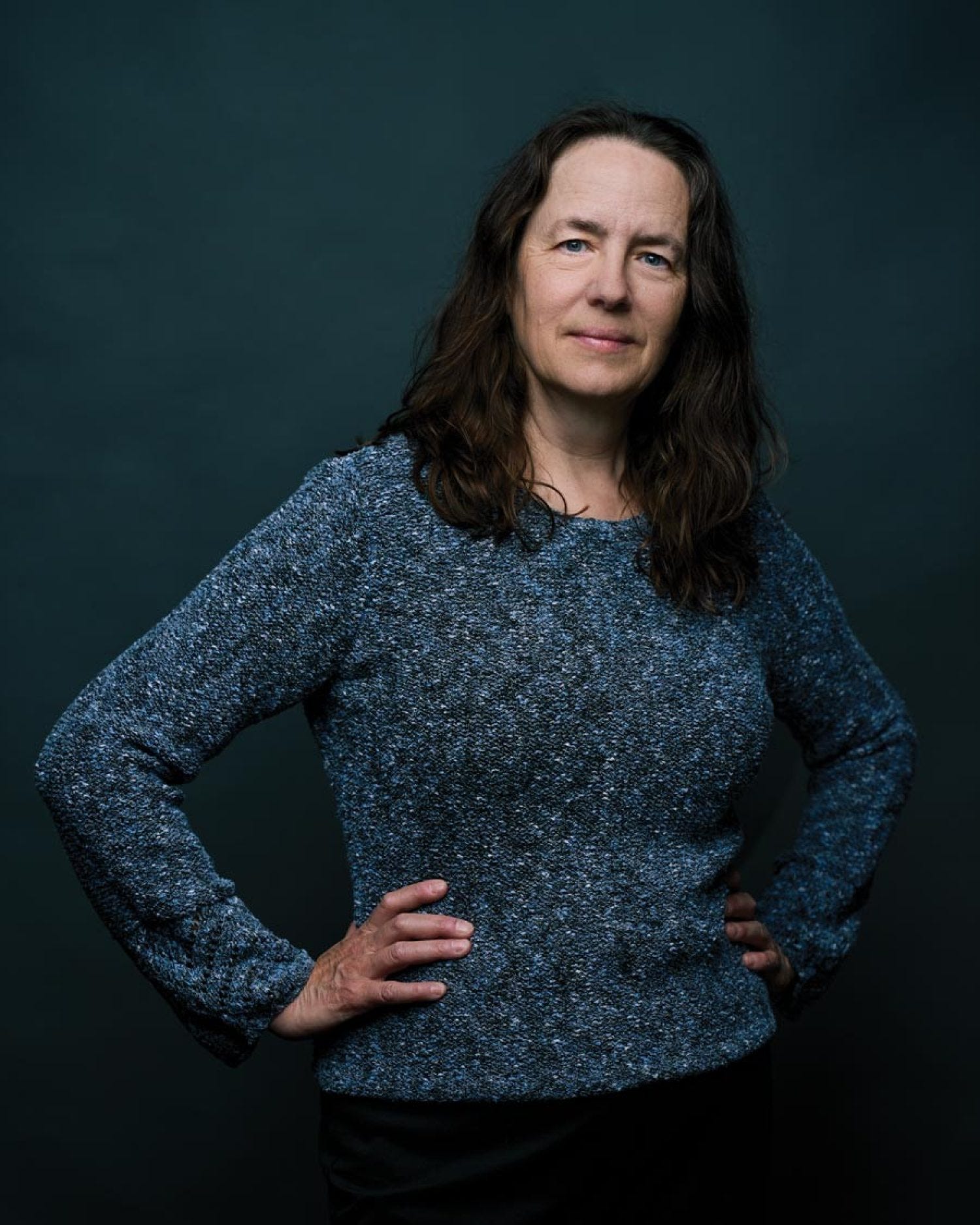
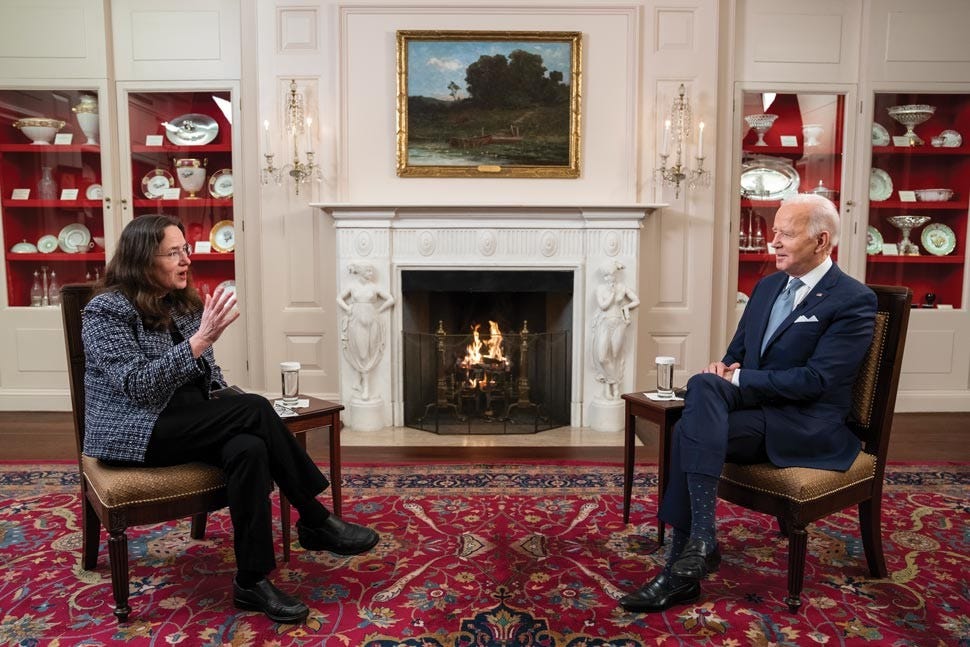
BC Professor Heather Cox Richardson with President Biden at the White House. It took a while for Richardson, a historian who often writes about past presidents, to get used to interviewing one who could actually answer her questions. Photo: Adam Shultz
How do you choose your essay topics? I’m not deliberately trying to push any arguments with my essays other than for multiracial democracy and liberal democracy. Beyond that, I am not pushing an argument except to the degree that I want people to understand the facts. I firmly believe in the Enlightenment concept that if people have true facts in front of them, they will make good decisions. They will not necessarily be the decisions that I would make, but they’re the decisions that make sense for them. And that’s how a pluralistic democracy works. So that’s my political point of view. But that means that as a person trained to be a teacher, I try to include voices that I don’t agree with but that are well grounded in facts, ones that simply present a different perspective. In terms of the topics I write about, I look at this in many ways as a chronicle of America for the graduate student in 150 years. So, which are the stories that are going to matter then? I try and look from that perspective and say, “This is important, and many of these other things are not.” And my historical training is very useful for that because, for example, I could look at the first speech that Antony Blinken gave when he became secretary of state in the Biden administration—which was not well covered in the media—and say, “Whoa, boy, this is a major shift in American foreign policy. This is the speech that’s going to be in textbooks and is going to be in monographs in 150 years.” Meanwhile, some other stuff in the news today really is going to be in the background in the future. So that’s how I choose my stories and how I figure out what’s going to be important.
How did you come up with the name Letters from an American? There is a very famous document in American history called Letters from an American Farmer. It’s by J. Hector St. John de Crèvecœur, and it’s very famous for the line, “What is this American, this new man?” And so it is partly saying, “what is America?” And I’m trying to explain what America is and keep a record of what America is. But there’s also a twentieth-century reference and that is Alistair Cooke’s Letter from America. And those were absolutely brilliant short snapshots, once a week, that really took off in the 1940s. Alistair Cooke, who was a journalist from England, took a look at America, saying “This is what America looks like today.” And he would cover everything from the 1948 reelection of Harry Truman to a tattoo artist. And it was his way of creating a kaleidoscope of what America looked like. And I thought those two things worked very well. That being said, it sounds like I was sitting around thinking great thoughts—I was literally running down the hallway in Stokes Hall with two of my graduate students going, “Oh my God, I got to have a name for this. What am I going to call it?” And we shopped it, the three of us, and this is what we came out with.
Writers are typically encouraged to write for their audience. Your audience is enormous. Do you write for your readers? I have a laptop and I sit alone in a room, and I don’t see those oceans of people out there. I write these letters to explain to about six friends the way the world works. My touchstone about what goes in a letter is always, would I send this to the six friends? Because the minute I start thinking about the people who are actually reading that letter, or the people that I would like to impress, or the people that I think are really cool, or the people I don’t like, I find I get paralyzed. So I sit there and I say, “Would I say this?” And one of the people is my college roommate. “Would I say this to my college roommate?” And if I would, then it goes in. And if I wouldn’t, then I figure I’m not writing authentically any longer.
“I firmly believe in the Enlightenment concept that if people have true facts in front of them, they will make good decisions. They will not necessarily be the decisions I would make, but that’s how a pluralistic democracy works.”
You have an especially large audience among women, people of color, and other groups that have traditionally been marginalized in our country. What makes your work so appealing to these readers? Well, I don’t know. I’ve never actually done a survey or anything like that, but I think that there are two pieces that matter. One is where my writing appears. Everything I write is available for free on Facebook, which is where the audience is. That’s where people are. Love or hate Facebook, there are billions of people on Facebook. So it’s very easy to get. It’s very accessible. I also think it doesn’t hurt that I’m not afraid to say I don’t understand something. And my great example of this was when Tom Cotton, a senator from Arkansas, wrote a letter during the Obama administration to Iran. The letter was signed by a whole bunch of senators. Afterward, there were a number of news articles that said, Well, he’s violated the Logan Act. And I was like, I have taught American history for thirty years, and I don’t know what the Logan Act is. Why are you all pretending that we know what the Logan Act is? So, literally, I went to Wikipedia. I’m like, Oh, that’s the Logan Act. It was a very simple law from the Quasi War with France in which a regular citizen had gone to try and cut a deal with France, to undercut the administration. And the Congress passed a law in 1799 saying you can’t do that. Okay. So that’s an explanation that journalists could include in a sentence. The fact that they didn’t made me feel really stupid, like, “Well, everybody else knows the Logan Act.” So part of what I do is always remind people. I even identify the president of the United States every night. That’s saying, You don’t have to remember this. I know that you have worked a ten-hour day and your car’s breaking down and the laundry’s dirty and you’re exhausted. You don’t have to remember who Adam Schiff is. I’m going to tell you who Adam Schiff is. And I think that helps this whole world be more accessible to people who otherwise feel like it’s a language that they don’t speak.
From the weakening of democratic norms to the pandemic to the insurrection, these are terrifying times, and it often feels like all of this is unprecedented. One thing that your readers learn is that we’ve often been here before. What is history’s role in informing modern public debate? We have been here before in many ways. We are currently in a brand-new moment in which we have a major political party that has rejected democracy. That is alarming and it is not completely unprecedented because, of course, this was the position of the Democratic party in the late 1850s. But in that case, those lawmakers and leaders left our government and tried to start their own. In this case, we have those same people remaining in the government, and this is new and dangerous. But I think that history’s primary role in this moment is providing the melody, perhaps, that we all sing: The reality that as Americans—and I mean this not only for native-born Americans but for the people who came to these shores a minute and a half ago—we share the same values, which have been embodied in particular documents, in particular people, and in particular events. It helps us to recognize that we have a shared reality, a shared set of aspirations, and a shared devotion to the common good. And I think of it like listening to a concert of somebody like James Taylor, where everybody in the audience knows the words to “Fire and Rain.” And part of you says, “why do they want to hear this song again?” And the answer is not because it’s breaking new musical ground for the audience, but because it reminds them that they are all in this ship together. And that, I think, is something that our shared history brings to this incredibly fraught moment.
Will the rise of social media and the spread of disinformation complicate or change the nature of the work that historians will be doing a hundred years from now? How will this affect history, and the way we do history? I think that’s a really interesting question because of course the real issue for archivists is curation. Whose voice gets to stay in the archives? Who gets to be there? And the proliferation of so many different forms of media and of speech means that we’re going to lose most of it. How many of your emails do you have from the late 1990s? I have none. I don’t have an archive. If it had all been on paper, I would, at this point in my life, have an archive. I don’t have one. That stuff’s going to get lost. And the question right now for archivists is, what do we keep? Why do we keep it? And what will that say about who America is at the end of the day? A lot of the reason we don’t understand that we have this whitewashed version of the past is because the only people who ended up in the archives were the white guys. And we did not, in fact, have a past that was uncontested at all. For example, if you were a follower of Joe McCarthy from Wisconsin in the 1950s, you were a fervent anti-Communist who was willing to hang people that you considered your enemies. And if you think about the 1930s, we literally had Nazis here in Boston. And those are stories that perhaps are less known, but it’s not like the past has not been contested. But at the same time, the modern explosion of media and of information offers the opportunity to include more voices in our archives, which will change the way we think about this history. When we talk about the construction of the idea of America, one of the things that has jumped out to me in the book I’m writing right now is that the people who have most clearly articulated what America means are people of color, are immigrants, and to some degree are women. And that, I think, is a really interesting reconstruction of what America means. Thomas Jefferson, Lincoln, FDR, these are the people who sit in our stone pantheons. And yet, if you think about the people who made the dream of America come alive, it’s Fannie Lou Hamer, a former sharecropper who was beaten almost to death for registering people to vote. It’s the Chinese American who was asked not long after the passage of the Chinese Exclusion Act in 1882 to donate money for the Statue of Liberty and responded, “I’m offended that you would ask me to give money for a statue dedicated to Liberty just after you’ve passed a law that says I am not welcome in this country.” It’s Frederick Douglass asking what—to an African American—is the Fourth of July? And that strikes me as being perhaps an obvious thing that I should have seen long ago. In terms of the way that we remember our history, maybe it’s time to recognize that the people who are keeping America alive are its marginalized peoples and its newcomers who recognize our dream in a way that those of us who have come to be somewhat blasé about it no longer do.
Do you see any way out of the disinformation swamp we seem to find ourselves in? That hits on what is in many ways the most interesting part of where we are for somebody who studies ideas. I think about disinformation in two ways. First, I look at it as an attack on our society, no different than a physical attack. And I think it has been quite deliberate to try and destabilize America. The efforts of people like Russian President Vladimir Putin to seed America with divisive concepts that tear us apart have been clearly established. So first of all, it’s an attack. But second of all, there’s a larger problem. And not just the foreign influences in America. There is the problem of the algorithms that enable people essentially to package social media users, to sell them. That’s been part of advertising since the beginnings of radio—people make the mistake of thinking that we are buying products, when in fact we are the product that advertisers buy—so that’s not exactly new. But what’s new are the algorithms that permit social media to privilege certain speech. And I see social media as we are currently using it, if you will, as a wild west. Every time we get a new technology, there aren’t rules around it, people misuse it. It’s got enormous potential to do good. It’s got enormous potential to do evil. Invariably, a lot of people jump in and do the evil with it. The society looks at this and says, “We can’t have this happen,” and they start to regulate it. And I expect that this is the direction we’re going now in America. The First Amendment means the government can’t say, “Hey, you’re not allowed to lie.” But what it can do is say, “you are not allowed to put warping algorithms on advertising,” for example, or on who sees what posts on Facebook.
What’s the problem with these algorithms? We know that Facebook privileged posts that created high emotion, especially anger. You were much more likely to see those posts than you were to see posts that created, for example, good feelings or no feelings at all. If you think about Facebook as a public sphere, that’s quite different than just seeing whatever comes along. Instead, you were literally being fed things that make you angry and that continue to lead you down a rabbit hole. And it’s not just Facebook that did this, of course. There are algorithms on YouTube. There are algorithms on TikTok. There are all sorts of ways in which people are steered into certain political directions. And I really think that’s pushing a lot of our polarization. I continue to believe that we are in an artificially polarized moment because of the way we have been steered into one way of looking at the world or another.
You’re someone who has studied and written about a number of long-deceased American presidents. And then, very recently, you had a chance to interview a living president, Joe Biden, and you got to do it in the seat of American power, the White House. It was really interesting because my White House is a historical White House. It’s a building full of memories and ghosts and paintings and statues and rooms and the Rose Garden. And I’d never been there before, and all of that is what I saw. And yet the White House is also, in the modern world, an office building. It’s full of people doing their jobs, and literally being like, “Hey George, do you have that envelope?” And those two things are overlapped when you’re there. I’m walking through history, I’m in an office building, and in some very small way, I’m making history because I’m interviewing a president. And that was also very odd because I know President Biden very, very well. But he’s on paper. I know his speeches. I know his videos. He is a historical figure to me. No different in many ways than FDR or Lincoln or Harding or any of those people who exist for me on paper and on screens. But he’s alive. He walked into the room and he talked to me and I got to ask him questions. And there was this moment of feeling like he wasn’t supposed to be three-dimensional and he wasn’t supposed to be able to answer my questions. And if he was going to answer my questions, I wanted him to give me the answers I wanted to hear . . . but he didn’t. And I’m like, Wait a minute, you’re not allowed to do that. You’re a historical figure. I get to do research and I get to figure out what the answer is. And then I get to write it. You’re not allowed to have your own opinions about your life.
That interview seemed to take your acclaim to a new level. What’s it like to be a media star now? [Laughs] When you put it that way, sure. But you don’t walk down the street thinking I’m going to interview the president of the United States. I am still absolutely the same person that was here five years ago or ten years ago. Sometimes I joke that I still feel like I’m twelve. I think we are who we are. And I’m a writer, I’m a teacher, and that’s what I do. I write and teach. I just have bigger audiences than I used to ten years ago.
What comes next for you? I’m making no plans at all. Everyone says to me, how long will you do the letters? And my answer to that is, they began absolutely organically and they will stop organically. We’ll know when it’s time for them to stop. People aren’t going to need them forever and then it will be time to do something else. I think that my life will depend a lot on what happens with the country. And right now, I feel incredibly fortunate to be part of this supportive, interesting, creative community that cares so deeply about this country. It is a wonderful community that is gathering. I also feel like I have been given the golden ring in that, for a historian, there is literally no better position in our entire history than to be the person who gets to keep the record of this era. And the fact that I fell into this—if you had told me three years ago that I was going to have this opportunity, I would be like, “Nah, never me.” But I happen to be in the right place at the right time. And that for somebody like me is an unfathomable gift.
The following is an article written by Tom Nichols in the Atlantic. Read about Nichols at Wiki if you want to know his background. He was born in our old stomping grounds (Western Massachusetts) of humble origins. Read what he did with himself. He is an example of the “American Dream”. Then listen to his thinking on democracy.
I am a “lefty semi-socialist” so I don’t subscribe to Tom’s basic political views. And I could never vote for Liz Cheney – despite her enormous contribution to the nation. My focus will always be on Universal Rights to education, healthcare, decent housing, clean water and food security – and most of all, the health of our Earth. So don’t assume I have “moved to the right”. Never going to happen.
But every nation needs a balance of political philosophies. And those on the right and the left need to agree to deal with each other respectfully to achieve some balance in policies and legislation. If there is a hope for an honorable center right political party, it lies with thinkers like Tom. Remember when a “conservative” could be viewed as a patriot and against all things totalitarian? There are still a few like Tom. His historical perspective is brilliant. So is his warning.
It’s Not Over
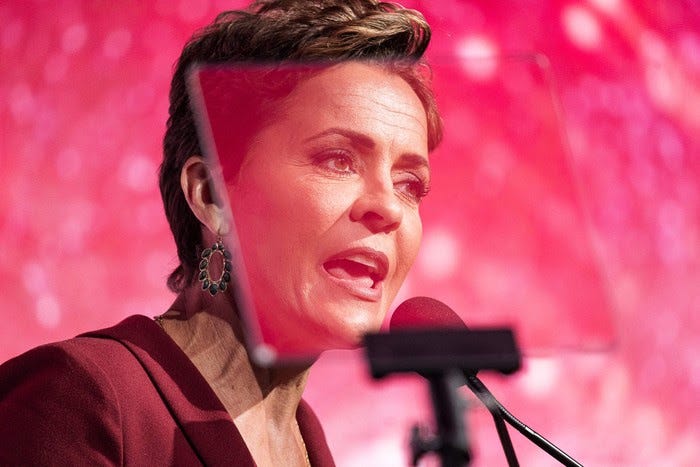
Kari Lake speaking during an election night watch party in Scottsdale, Arizona, on November 8, 2022. (Olivier Touron / AFP / Getty)
November has been a good month for democracy. Brazil’s autocratic president, Jair Bolsonaro, authorized the transfer of power after losing in national elections to a left-wing challenger. Russia’s murderous army is literally on the run in Ukraine. And American voters went to the polls and defied both history and expectation: They left the Senate in the hands of Democrats, gave the House to the Republicans by only a tiny majority, and crushed the electoral aspirations of a ragtag coalition of election deniers, Christian nationalists, and general weirdos.
That’s the good news. But as relieved as I am that some of my darkest worries did not come to pass last week, democracy is still in danger. What happened last week was an important electoral victory that allows all of us to fight another day—specifically, two years from now. Without the defeat of the deniers in 2022, the 2024 elections would likely have fallen into chaos and perhaps even violence. Both are still possibilities. But voters rallied and turned back the worst and most immediate threats to the American system of government.
Think of last week as American democracy’s Dunkirk: an improvised but crucial escape from disaster. I generally dislike World War II metaphors; most things we do are nowhere near the scale of the fight to defeat the Axis. But I’m going to break my own rule here because I worry about too much complacency among the prodemocracy coalition.
If you’re fuzzy on your 20th-century history, Dunkirk was the beach in France where the Nazis trapped retreating Allied forces, mostly hundreds of thousands of British troops, after the fall of France in 1940. Had these units been destroyed, the United Kingdom might well have faced the prospect of surrender to Nazi Germany. Instead, the Germans hesitated to close the noose, and nearly 350,000 men were evacuated to Britain by a flotilla composed mostly of civilian volunteers, a miraculous feat that protected Britain from invasion and bought time until the American entry into the war.
Like Dunkirk, the midterms were a necessary, but not final, victory. The old saw about “the most important election in our lifetime” turned out to be true this time: Without multiple defeats of the worst state and federal candidates in recent history, the unraveling of American democracy would have accelerated and the security of future elections would be in doubt, at least in the states captured by the election deniers and their associated charlatans.
If you want a vision of what such a nightmare might look like, imagine a close election in 2024. Battleground states are counting ballots with armed people swarming around election sites and state offices. Arizona Governor Kari Lake, Pennsylvania Governor Doug Mastriano, and Wisconsin Governor Tim Michels are all frantically calling and texting one another on Election Night, and ordering their state institutions to hold off on finalizing the results. Meanwhile, Arizona Secretary of State Mark Finchem (a former member of the Oath Keepers) reaches out to his like-minded counterparts—Jim Marchant in Nevada, Kristina Karamo in Michigan—to ensure that none of them will certify Democratic wins, perhaps in hopes of flipping the decision to their legislatures or sympathetic judges. If Karamo misses the call, it’s because she’s busy strategizing with Michigan’s new Republican governor, Tudor Dixon, a conspiracy-theory-spouting flake who thinks that COVID restrictions and the George Floyd protests were an attempt to topple the U.S. government.
Fortunately, all of these people were soundly defeated—except for Lake, who lost in a squeaker and, true to form, still refuses to concede to Democrat Katie Hobbs. But among them, they garnered millions of votes. These 2022 losers and other, similar candidates are still out there, and they will all continue their best efforts (as Lake is demonstrating) to corrode the foundations of our constitutional order.
Which brings us to Donald Trump.
As I wrote a few days ago, Trump’s 2024 candidacy confronts us, once and for all, with a decision about what kind of country we are. I hope that the Republicans deny him their nomination: A spirited fight within the GOP that ends by flushing Trump out of the American political system would be good for the Republicans and for America. But I have no faith in the regenerative power of a party that has devolved into an anti-constitutional, violent movement led by cowards and opportunists. Especially because the current crop of possible GOP contenders is just another collection of poltroons and Trump imitators; the Republican primaries are likely only to replace one authoritarian cult leader with another.
American democracy’s Dunkirk means that the danger to the 2024 election from chicanery and outright attack, both political and physical, is much lower now than even a month ago. Turnout in 2022 was high, as midterms go, but not high enough, particularly—and as usual—among young voters, whose turnout, at just over 27 percent, was actually lower than in 2018 (when it hit its highest level ever). And we’re stuck for years to come with some truly odious candidates who managed to get past the voters. (I am, of course, speaking of J. D. Vance here, among others.) The Kari Lakes and the Tudor Dixons will resurface in two years. If we are going to turn them back once and for all, we must not underestimate their resentment and will to power. We know who they are; we must decide who we are.
We are two days away from the very consequential “Mid-Term” Elections. For some of us it is a referendum on Joe Biden’s presidency and the historic legislation passed in his first year and one half. For many it is a call to preserve democracy itself.
Millions of Americans actually think that politicians create inflation. And they would traditionally vote out the current party as a payback. Of course, the Republicans don’t have any more control over prices than Democrats. Inflation is a natural economic cycle – this time fed by high demand and a shortage of product and materials (not high wages as the Federal Reserve would lead you to believe). Supply chains are fragile. The pandemic and the explosive rapid recovery revealed the flaws in our “just in time” inventory management. Profits prevailed over practical planning.
Who controls the price of gasoline? Hint. It’s not ANY politician.
And then there is the “profit pricing” by companies who under the cover of inflation publicity have achieved record breaking profits – which they have announced they will use to buy back their own stock. Corporations profit, we suffer.
For others it’s a battle for the integrity of our entire electoral system. Do we accept the results of elections we find disappointing? I can’t believe I actually typed that, of course.
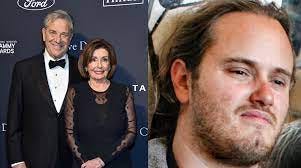
“Where is Nancy? I am going to break her knee caps!”
And worst of all, the lies, the lies, the lies. The husband of the Speaker of the House of Representatives is assaulted in his own home. Video footage records the assailant breaking in through a glass door with a hammer. Our former President has the audacity to suggest that the door was broken from the inside – he called it a possible “inside job”. People will believe this bullshit. So it is tempting to think we have sunk to the lowest levels in our history when it comes to lies and squabbles. Not true. In fact we have been this way forever.
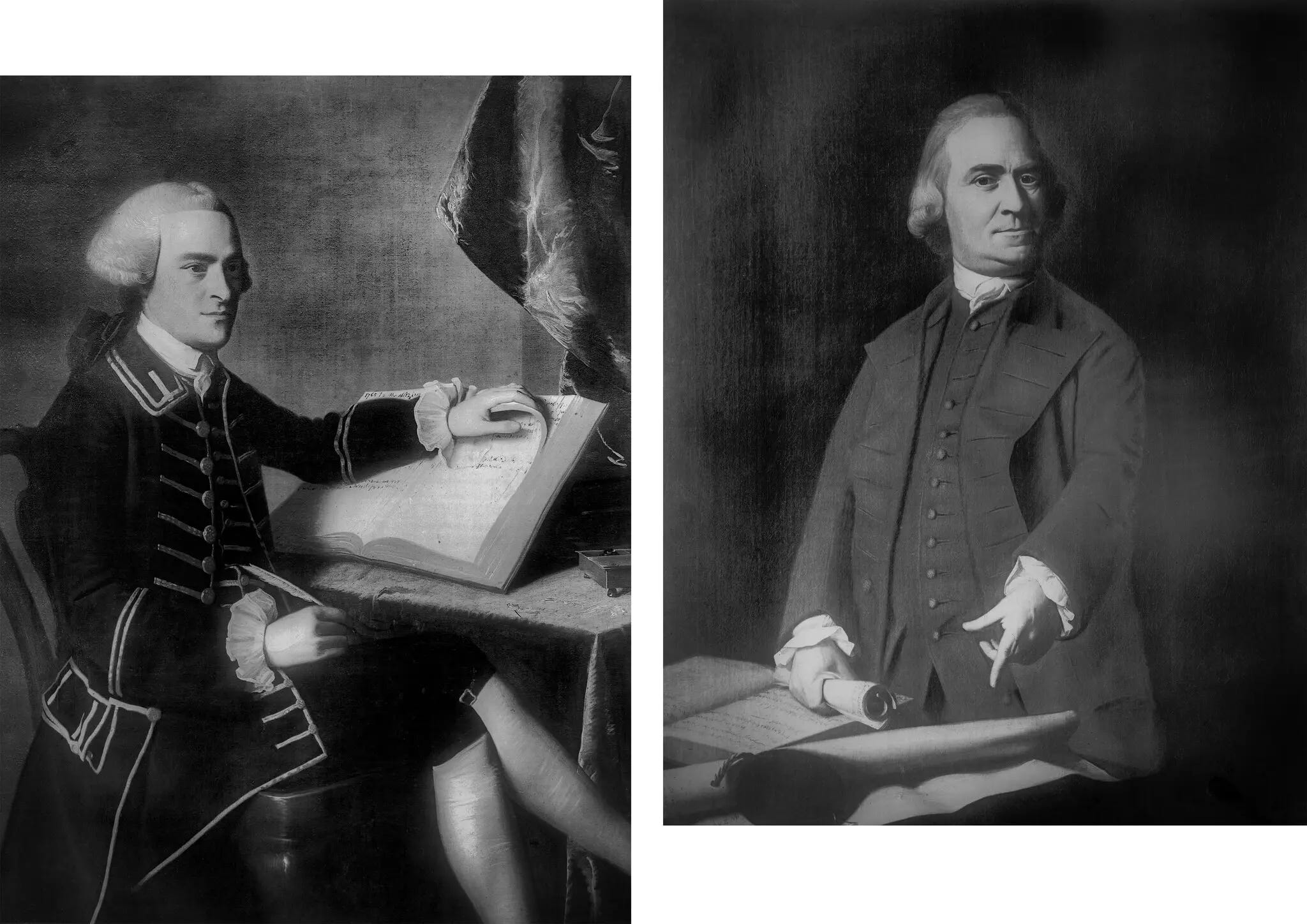
Young rich John Hancock was mentored by political operative Samuel Adams
Stacy Schiff explains in her opinion piece. The link below bypasses the NY Times pay wall. Good perspective just when we think things are falling apart…which they are. If you have ever lived in Massachusetts, you will be especially entertained. Read it here: John Hancock and Samuel Adams are Still Fighting for the Nation’s Soul
Many of us already have voted. If you haven’t yet, PLEASE do. We need to send a message to the liars. And for those of us who reside in Massachusetts, we look forward to our first elected Woman Governor. The guys have made a mess of things going back to John and Sam. Time for a change.
I am publishing this to correct a misunderstanding and share with you something that seems to be trending lately: The CON.
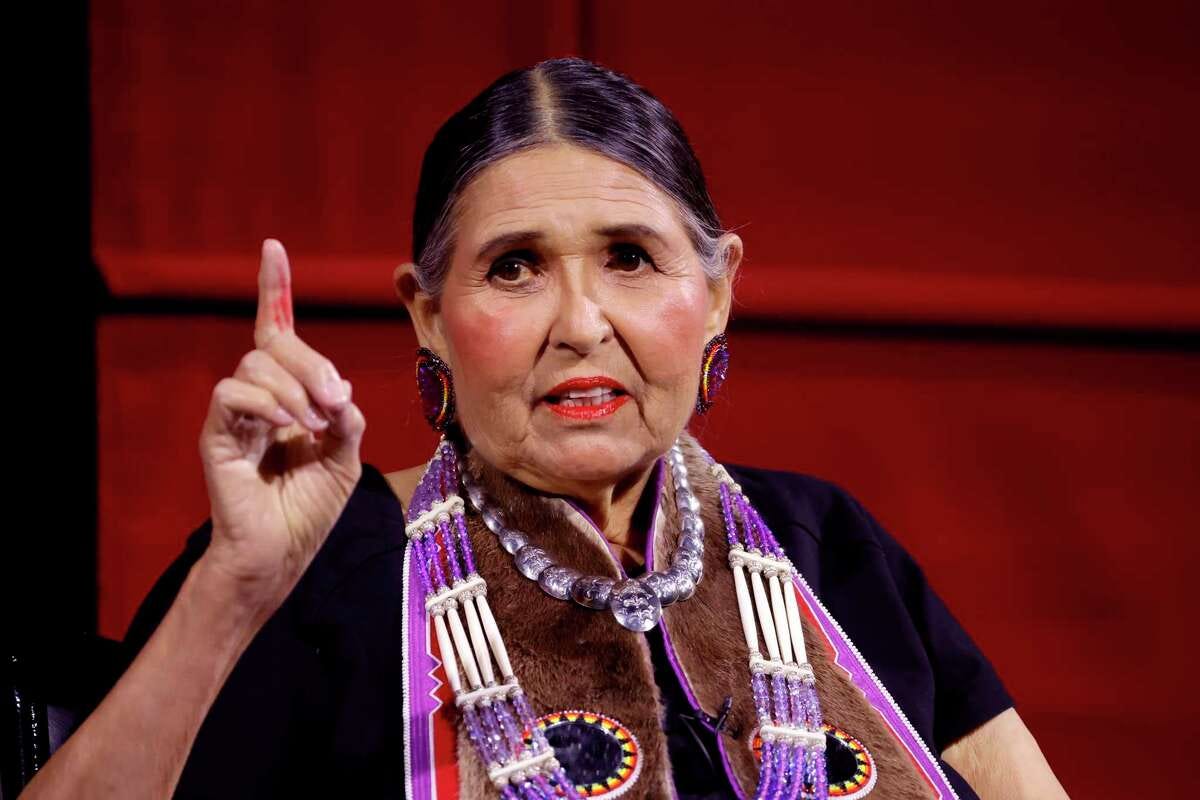
I wrote this piece about Sacheen Littlefeather in August. We felt proud of her. But I have just read that she was a liar. The article below reflects interviews with her two sisters. They have no Indigenous American blood. Sacheen was a con artist and a liar. What she spoke of – how Native Americans have been mistreated is absolutely true. But now that she has passed, her family has exposed her for what she was. Wow. And sad. Read the article below. She was a “pretendian”.
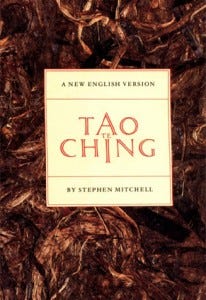
Below is a copy and paste (just part of the forward) from Stephen Mitchell’s “interpretation” of the Tao Te Ching. I first read this over 30 years ago. No book has had a greater impact on me than his version. When I find myself in a pool of angst, I pull out my dog eared yellowing copy of this book. I experience a feeling of calmness immediately. The calmness is supplemented by wonder and hope.
Upon my first reading, I found it to be somewhat obtuse and mystifying. But that melted away as the brilliance of this philosophy began to penetrate my stubborn brain. It began to feel “natural”. And comforting. It also challenges much of our still primitive basic human nature. Things like “fight or flight” are hard to suppress.
The Tao is not a religion. There is no deity. There is no “house of worship”. The only “tithing” is that of offering good will. I like it. You may also enjoy the last line in my “copy and paste”.
A NEW ENGLISH VERSION
HARPERCOLLINS 1988
Lao-tzu’s Tao Te Ching, or Book of the Way, is the classic manual on the art of living, and one of the wonders of the world. In eighty-one brief chapters, the Tao Te Ching looks at the basic predicament of being alive and gives advice that imparts balance and perspective, a serene and generous spirit. This book is about wisdom in action. It teaches how to work for the good with the effortless skill that comes from being in accord with the Tao (the basic principle of the universe) and applies equally to good government and sexual love; to child rearing, business, and ecology.
Stephen Mitchell’s bestselling version has been widely acclaimed as a gift to contemporary culture.
EXCERPTS
FOREWORD
Tao Te Ching (pronounced, more or less, Dow Deh Jing) can be translated as The Book of the Immanence of the Way or The Book of the Way and of How It Manifests Itself in the World or, simply, The Book of the Way. Since it is already well known by its Chinese title, I have let that stand.
About Lao-tzu there is practically nothing to be said. He may have been an older contemporary of Confucius (551-479 BCE) and may have held the position of archive-keeper in one of the petty kingdoms of the time. But all the information that has come down to us is highly suspect. Even the meaning of his name is uncertain (the most likely interpretations: “the Old Master” or, more picturesquely, “the Old Boy”). Like an Iroquois woodsman, he left no traces. All he left us is his book: the classic manual on the art of living, written in a style of gemlike lucidity, radiant with humor and grace and largeheartedness and deep wisdom: one of the wonders of the world.
People usually think of Lao-tzu as a hermit, a dropout from society, dwelling serenely in some mountain hut, unvisited except perhaps by the occasional traveler arriving from a ’60s joke to ask, “What is the meaning of life?” But it’s clear from his teachings that he deeply cared about society, if society means the welfare of one’s fellow human beings; his book is, among other things, a treatise on the art of government, whether of a country or of a child. The misperception may arise from his insistence on wei wu wei, literally “doing not-doing,” which has been seen as passivity. Nothing could be further from the truth.
A good athlete can enter a state of body-awareness in which the right stroke or the right movement happens by itself, effortlessly, without any interference of the conscious will. This is a paradigm for non-action: the purest and most effective form of action. The game plays the game; the poem writes the poem; we can’t tell the dancer from the dance.
Less and less do you need to force things, until finally you arrive at non-action. When nothing is done, nothing is left undone.
Nothing is done because the doer has wholeheartedly vanished into the deed; the fuel has been completely transformed into flame. This “nothing” is, in fact, everything. It happens when we trust the intelligence of the universe in the same way that an athlete or a dancer trusts the superior intelligence of the body. Hence Lao-tzu’s emphasis on softness. Softness means the opposite of rigidity, and is synonymous with suppleness, adaptability, endurance. Anyone who has seen a t’ai chi or aikido master doing not-doing will know how powerful this softness is.
Lao-tzu’s central figure is a man or woman whose life is in perfect harmony with the way things are. This is not an idea; it is a reality; I have seen it. The Master has mastered Nature; not in the sense of conquering it, but of becoming it. In surrendering to the Tao, in giving up all concepts, judgments, and desires, her mind has grown naturally compassionate. She finds deep in her own experience the central truths of the art of living, which are paradoxical only on the surface: that the more truly solitary we are, the more compassionate we can be; the more we let go of what we love, the more present our love becomes; the clearer our insight into what is beyond good and evil, the more we can embody the good. Until finally she is able to say, in all humility, “I am the Tao, the Truth, the Life.”
The teaching of the Tao Te Ching is moral in the deepest sense. Unencumbered by any concept of sin, the Master doesn’t see evil as a force to resist, but simply as an opaqueness, a state of self-absorption which is in disharmony with the universal process, so that, as with a dirty window, the light can’t shine through. This freedom from moral categories allows him his great compassion for the wicked and the selfish.
Thus the Master is available to all people and doesn’t reject anyone. He is ready to use all situations and doesn’t waste anything. This is called embodying the light.
What is a good man but a bad man’s teacher? What is a bad man but a good man’s job? If you don’t understand this, you will get lost, however intelligent you are. It is the great secret.
The reader will notice that in the many passages where Lao-tzu describes the Master, I have used the pronoun “she” at least as often as “he.” The Chinese language doesn’t make this kind of distinction; in English we have to choose. But since we are all, potentially, the Master (since the Master is, essentially, us), I felt it would be untrue to present a male archetype, as other versions have, ironically, done. Ironically, because of all the great world religions the teaching of Lao-tzu is by far the most female. Of course, you should feel free, throughout the book, to substitute “he” for “she” or vice versa.
….the above is a portion of the forward of Mitchell’s book.
My fellow substack writer, Dave Conant, just posted this video in his letter. He gave me the go ahead to share it. It is a revelation about where and how our water is employed. And it was a big surprise to me. The video is not long. But it is very well produced and it will get you thinking new thoughts about water and what we eat.








 Bill's Focus