• Thousands of local threats to our votes


    If you think that voter suppression laws are a threat to free and fair elections, you are right. While scary and upsetting, they do impact Republican voters as well. So there’s that.

    But something else in the fascist Republican playbook is perhaps a greater threat and it is described in this well researched and Terrifying Video. I have linked this as a gift article so even if you are not a NY Times subscriber, it will be viewable.

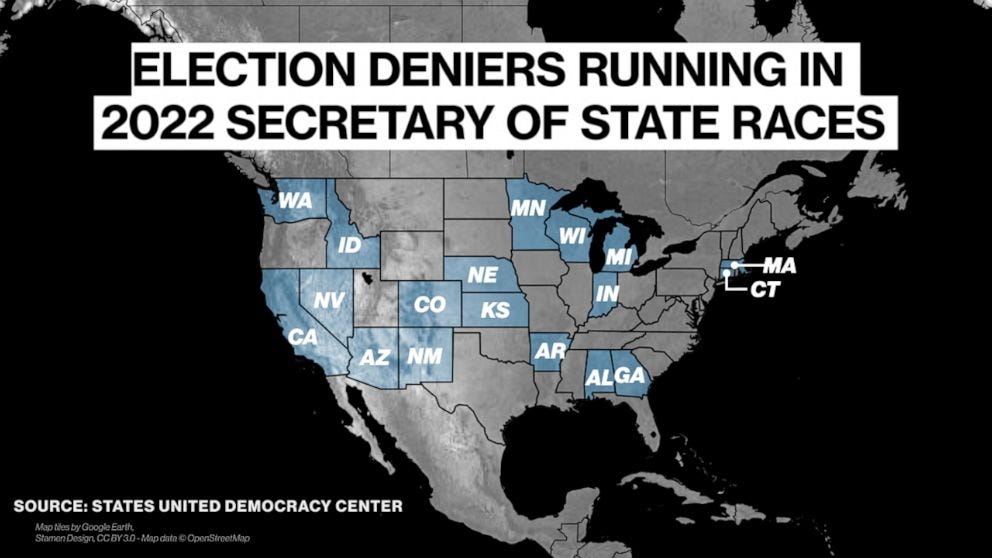
    Just as radical Republicans have infiltrated the court system with Federalist Society hack judges, the very mechanics of our election apparatus at the most basic level are being invaded by recruited operatives to challenge the valid results of well run elections. Democracy and your precious vote are under attack.

    The Secretary of State accepts and certifies the election results – unless he is a “denier”. In the GQP instruction manual an election lost is an election stolen. But the threat is even more insidious than the Secretary of State races. Watch the video and ask your local election board or officials how they plan to handle this.

  • But Be Glad She’s Here


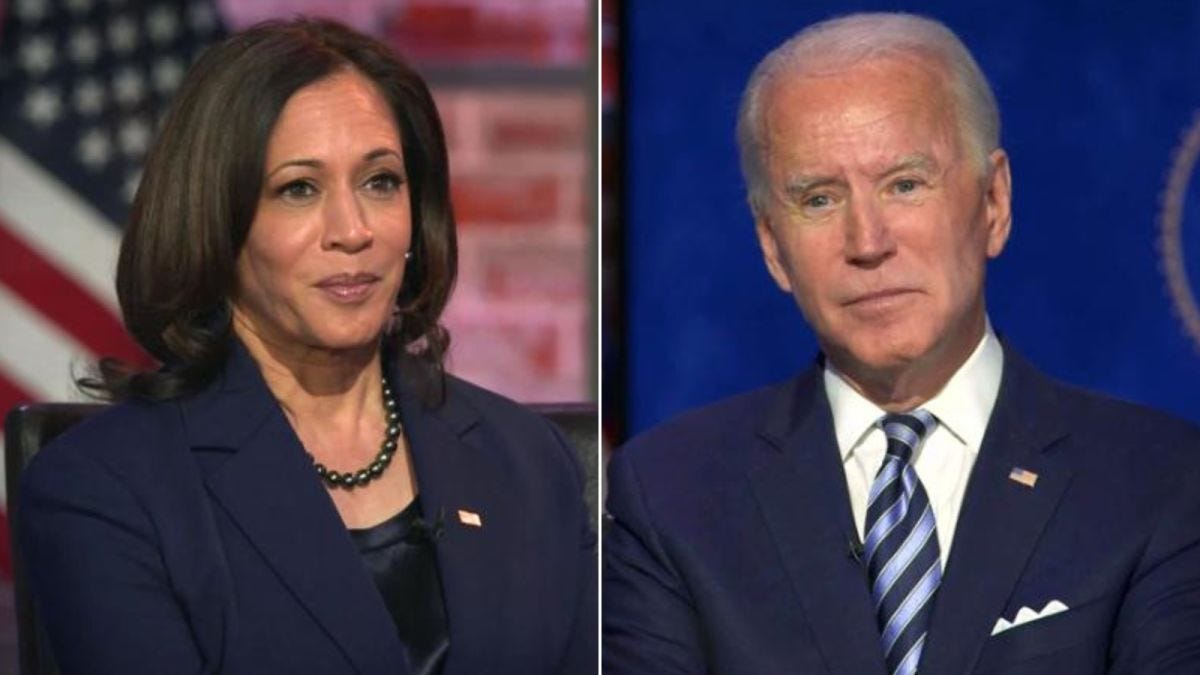
    We don’t watch much television news. It’s all too often just the sensationalization of what we have already read. But yesterday I came upon a link to an interview by Chuck Todd (NBC, MSNBC). He spoke with Vice President Kamala Harris.

    Much like a President, one of a VP’s jobs is to take criticism. Be a punching bag for lazy reporters. “She is too much in the background.” or “She has no political traction.” or “She is not polling well.” Well, this VP is one tough cookie. So no worries in this department. She can duck sucker punches. And then she tells it like it is without the gaffes.

    The other big VP’s job is to speak in support of the administration’s agenda. To back up the President’s vision and actions. Below is a link to VP Harris doing that quite well.

    Of course, the central job of a VP of the US is to be available if the President is unable to perform his duties. I came away from this interview reassured that this VP is extraordinarily qualified and ready to step into the big job in a heart beat.


    https://www.nbcnews.com/meet-the-press/video/full-harris-very-concerned-about-u-s-message-on-democracy-148160069503

    The purpose of this letter is not to suggest that Harris should be a “shoe in” nominee in 2024. I do think President Biden will decide not to run and he will make that announcement sometime in 2023. While Harris has to be a contender, the Democratic bench is deep. And I would recommend such speculation be suspended until well after the Mid Term elections.

    For now, please promise me you will vote on November 8. And please promise me you will encourage, cajole, arm twist, blackmail or kidnap as many Democrats and intelligent Independents as possible to participate in defeating the Forces of Doom.

    For now be glad we have Biden-Harris. A team to be grateful for. A highly successful steady and seasoned Captain of good heart and a First Mate ready for the helm if he were to be washed away.

  • Better late than never?

    I ripped off this piece from the NYTimes – so those of you who hit the “paywall” may read it.

    Sacheen Littlefeather was booed and cheered after she explained that she was representing Marlon Brando and that he could not accept the award because of “the treatment of American Indians today by the film industry.”Credit…Bettmann/Getty Images

    My comments:
    I am no fan of the Oscars. Most people are. They love the excitement, the drama, the dresses. They cheer on their favorite films. It’s like a sport. To each his own. Love it or not.

    I love movies, but watching all that ceremony that desperately tries to elevate one film or actor above another is just not interesting to me. Declaring one film as the “best” just doesn’t make any sense to me. It’s comparing apples and oranges. But the Oscars has become embedded in our culture. And every once in a while it connects with the culture of real life.

    Here is a Hollywood story you probably won’t read because TFG is dominating the headlines – despite the fact that our President has just signed the most significant legislation in modern history. That is if you believe the Climate Crisis is real. If not, you can go back to supporting a con man who has stolen top secret files from the government he was sworn to protect. But I digress.

    This article is significant because it reminds me of our history of brutal treatment of indigenous people in North America. Our kids should know about this in the same way Germans know about the Holocaust. They should know about the genocide Europeans performed on Ms. Littlefeather’s people. As a kid I grew up playing “cowboys and Indians”. John Wayne was a universally loved Hollywood hero. Now I know he was just another bigot and a true asshole.

    An Oscars Apology for Sacheen Littlefeather, 50 Years After Brando Protest

    The Apache activist and actress was booed onstage in 1973 after she refused the best actor award on Marlon Brando’s behalf and criticized Hollywood for its depictions of Native Americans.

    By Amanda Holpuch

    Aug. 16, 2022

    The Academy of Motion Picture Arts and Sciences has apologized to Sacheen Littlefeather, an Apache and Yaqui actress and activist who was booed onstage at the Oscars in 1973 after she refused the best actor award on behalf of Marlon Brando.

    The Academy said in a statement on Monday that it had apologized to Ms. Littlefeather, 75, in June, nearly 50 years after Ms. Littlefeather pierced through the Academy Awards facade of shiny statues and bright lights in 1973 and injected the ceremony with criticism about Native American stereotypes in media.

    Her appearance at the ceremony, the first time a Native American woman stood onstage at the Academy Awards, is perhaps one of the best-known disruptive moments in the history of the award ceremony.

    When Ms. Littlefeather, then 26, spoke, some of the audience cheered her and others jeered. One actor, John Wayne, was so unsettled that a show producer, Marty Pasetta, said security guards had to restrain him so that he would not storm the stage.

    Ms. Littlefeather said she was “stunned” by the apology in an interview with The Hollywood Reporter. “I never thought I’d live to see the day I would be hearing this, experiencing this,” she said.

    “When I was at the podium in 1973, I stood there alone,” she added.

    Ms. Littlefeather also brought attention to the federal government’s standoff at Wounded Knee with Native Americans in the 1973 speech, which she came up with shortly before being called onstage on behalf of Mr. Brando, who was to receive the best actor award for his performance as Vito Corleone in “The Godfather.”

    Ms. Littlefeather said in an interview with the Academy, which was published on Monday, that she had been planning to watch the 45th Academy Awards on television like everyone else when she received a call the night before the ceremony from Mr. Brando. The two had become friends through her neighbor, the director Francis Ford Coppola. Mr. Brando asked her to refuse the award on his behalf if he won.

    Ms. Littlefeather arrived at the ceremony with only about 15 minutes left of the official program, wearing a glimmering buckskin dress, moccasins and hair ties. Ms. Littlefeather said she had little information about how the night would work, but Mr. Brando had given her a speech to read if he won.

    That plan evaporated when a producer for the Oscars saw the pages in her hand and told he she would be arrested if her comments lasted more than 60 seconds, she said.

    She introduced herself, then explained that Mr. Brando would not be accepting the award because of his concerns about the image of Native American people in film and television and by the government. She paused when a mix of boos and cheers erupted from the audience.

    “And I focused in on the mouths and the jaws that were dropping open in the audience, and there were quite a few,” she told the Academy. “But it was like looking into a sea of Clorox, you know, there were very few people of color in the audience.”

    The crowd quieted, and Ms. Littlefeather mentioned the Wounded Knee standoff and then left the stage without touching the golden Oscars statue. She said some audience members did the so-called “tomahawk chop” at her and that when she went to Mr. Brando’s house later, people shot at the doorway where she was standing.

    “When I went back to Marlon’s house, there was an incident with people shooting at me,” she said. “And there were two bullet holes that came through the doorway of where I was standing, and I was on the other side of it.”

    Ms. Littlefeather, who was not available for an interview on Tuesday, told the Academy that speaking about these events in 2022 “felt like a big cleanse.”

    “It feels like the sacred circle is completing itself before I go in this life,” said Ms. Littlefeather, who told The Guardian in June 2021 that she had terminal breast cancer.

    The former president of the Academy, David Rubin, wrote in the apology to Ms. Littlefeather that the abuse she faced because of the speech was “unwarranted and unjustified.”

    “For too long the courage you showed has been unacknowledged,” Mr. Rubin wrote. “For this, we offer both our deepest apologies and our sincere admiration.”

    Mr. Rubin’s letter will be read next month at a program at the Academy Museum of Motion Pictures, “An Evening with Sacheen Littlefeather.”

    The Academy described it as an event of “conversation, reflection, healing and celebration.” Ms. Littlefeather said in a statement that she was looking forward to the Native American performers and speakers at the event, including Calina Lawrence, a Suquamish singer, and Bird Runningwater, the co-chair of the Academy’s Indigenous Alliance, who is Cheyenne and Mescalero Apache.

    “It is profoundly heartening to see how much has changed since I did not accept the Academy Award 50 years ago,” she said. “I am so proud of each and every person who will appear onstage.”

  • 25 Years of Lies and Obstruction


    “The GOP is Sick. It didn’t start with Trump – and won’t end with him.”
    This is the title of an opinion piece in the Washington Post of August 4th.

    Many of you may hit a paywall when trying to read this essential piece by Dana Milbank. Here is a “gift link” to the original. https://wapo.st/3BRPHaP
    Please read it or listen to an audio version included on the page.


    If you are of a certain age, you will remember this litany of offenses by a party captured by liars. If you are a bit younger, here is a primer on how a once proud and principled political party – the party of Abe, Teddy and Ike – turned itself into a machine willing to do and say anything – no matter how vile or how false – to gain and retain power. This is right out of a play book that could have been written by Hitler or by Stalin. It is a George Orwell novel come true. It is happening here in the USA.

  • A Blueprint for a Real Democracy


    Doomerism. Doom scrolling. Facing the “fire hose” of fascists finagling with our fragile democracy. It’s depressing and it is exhausting. It can cause us to shut down. A natural defense mechanism to prevent an emotional collapse. I get it. I suggest we compartmentalize this horror of a formerly legitimate political party attempting a coup. Learn about it. Get up to date. And then put it in a box.

    It’s natural to be overwhelmed. But take a break. Then find some healthy aspects of life. Family and friends. A walk with a podcast or your favorite tunes. A run that clears the brain. Put your hands in the Earth to grow something. Go for a swim or just sit by a beach and listen to the waves. Whatever it takes to find a balance in your head. Park the madness. Rest and regroup.


    And then, once refreshed, return to the fight for our nation. There is a revolution happening. Not a good one. Very, very rich people have convinced the less than rich people that elections are rigged (they are not) and that democracy is code for letting in the “others” who will steal their money and jobs (jobs are available at record numbers). The US has a significant racist and bigoted history and present that many want to ignore. However, it CAN happen here. It has. It is.

    New Jersey July 18, 1937


    How do we fight this battle? How can we actually shift back to a democracy where every vote counts? Some really smart and highly educated people have some terrific ideas how we can reclaim this nation for democracy. A blueprint – a plan our founders would applaud!


    In 2018 the American Academy of Arts and Sciences launched a bipartisan Commission on the Practice of Democratic Citizenship. The Academy was created in 1780 and among it’s earliest founders and members were John Adams, John Hancock and Thomas Jefferson.

    In 2020 the Commission issued  31 recommendations for strengthening democracy in the report Our Common Purpose: Reinventing American Democracy for the 21st Century. They included reform to political institutions, investment in civil society, and transforming our political culture. Learn more about the people and the process that produced Our Common Purpose here

    Here is a condensed version of the “Common Purpose Action Plan”. Read this and become hopeful! Read this and see that there are wonderful ideas about reforming our institutions and teaching our citizens how to participate. IMO, it is a masterpiece of a “master plan” to rebuild our nation and defeat the Fascist Revolution that threatens our way of life and the Earth itself.


    The Fascists will never disappear. But they can be marginalized. They can be outvoted and prosecuted for sedition. Let’s make it so. In the meantime, let’s rebuild.
    Here is a plan. Read here for the complete detailed recommendations. Below is a summary.

    I like all of Number 1. But I love 1.6 and 1.8. I have great enthusiasm for 2.5 and 6.1.

    Strategy 1: Achieve Equality of Voice and Representation

    RECOMMENDATION 1.1

    Substantially enlarge the House of Representatives through federal legislation to make it and the Electoral College more representative of the nation’s population.

    RECOMMENDATION 1.2

    Introduce ranked-choice voting in presidential, congressional, and state elections.

    RECOMMENDATION 1.3

    Amend or repeal and replace the 1967 law that mandates single-member districts for the House, so that states have the option to use multi-member districts on the condition that they adopt a non-winner-take-all election model.

    RECOMMENDATION 1.4

    Support adoption, through state legislation, of independent citizen-redistricting commissions in all fifty states. Complete nationwide adoption, through federal legislation, that requires fair congressional districts to be determined by state-established independent citizen-redistricting commissions; allows these commissions to meet criteria with non-winner-take-all models; and provides federal funding for these state processes, with the goal of establishing national consistency in procedures.

    RECOMMENDATION 1.5

    Amend the Constitution to authorize the regulation of election contributions and spending to eliminate undue influence of money in our political system, and to protect the rights of all Americans to free speech, political participation, and meaningful representation in government.

    RECOMMENDATION 1.6

    Pass strong campaign-finance disclosure laws in all fifty states that require full transparency for campaign donations, including from 501(c)(4) organizations and LLCs.

    RECOMMENDATION 1.7

    Pass “clean election laws” for federal, state, and local elections through mechanisms such as public matching donation systems and democracy vouchers, which amplify the power of small donors.

    RECOMMENDATION 1.8

    Establish, through federal legislation, eighteen-year terms for Supreme Court justices with appointments staggered such that one nomination comes up during each term of Congress. At the end of their term, justices will transition to an appeals court or, if they choose, to senior status for the remainder of their life tenure, which would allow them to determine how much time they spend hearing cases on an appeals court.

    Strategy 2: Empower Voters

    RECOMMENDATION 2.1

    Give people more choices about where and when they vote, with state-level legislation in all states that supports the implementation of vote centers and early voting. During an emergency like COVID-19, officials must be prepared to act swiftly and adopt extraordinary measures to preserve ballot access and protect the fundamental right to vote.

    RECOMMENDATION 2.2

    Change federal election day to Veterans Day to honor the service of veterans and the sacrifices they have made in defense of our constitutional democracy, and to ensure that voting can occur on a day that many people have off from work. Align state election calendars with this new federal election day.

    RECOMMENDATION 2.3

    Establish, through state and federal legislation, same-day registration and universal automatic voter registration, with sufficient funding and training to ensure that all government agencies that have contact with citizens include such registration as part of their processes.

    RECOMMENDATION 2.4

    Establish, through state legislation, the preregistration of sixteen- and seventeen-year-olds and provide educational opportunities for them to practice voting as part of the preregistration process.

    RECOMMENDATION 2.5

    Establish, through congressional legislation, that voting in federal elections be a requirement of citizenship, just as jury service is in the states. All eligible voters would have to participate, in person or by mail, or submit a valid reason for nonparticipation. Eligible voters who do not do so would receive a citation and small fine. (Participation could, of course, include voting for “none of the above.”)

    RECOMMENDATION 2.6

    Establish, through state legislatures and/or offices of secretaries of state, paid voter orientation for voters participating in their first federal election, analogous to a combination of jury orientation and jury pay. Most states use short videos produced by the state judicial system to provide jurors with a nonpolitical orientation to their duty; first-time voters should receive a similar orientation to their duty.

    RECOMMENDATION 2.7

    Restore federal and state voting rights to citizens with felony convictions immediately and automatically upon their release from prison, and ensure that those rights are also restored to those already living in the community.

    Strategy 3: Ensure the Responsiveness of Government Institutions

    RECOMMENDATION 3.1

    Adopt formats, processes, and technologies that are designed to encourage widespread participation by residents in official public hearings and meetings at local and state levels.

    RECOMMENDATION 3.2

    Design structured and engaging mechanisms for every member of Congress to interact directly and regularly with a random sample of their constituents in an informed and substantive conversation about policy areas under consideration.

    RECOMMENDATION 3.3

    Promote experimentation with citizens’ assemblies to enable the public to interact directly with Congress as an institution on issues of Congress’s choosing.

    RECOMMENDATION 3.4

    Expand the breadth of participatory opportunities at municipal and state levels for citizens to shape decision-making, budgeting, and other policy-making processes.

    Strategy 4: Dramatically Expand Civic Bridging Capacity

    RECOMMENDATION 4.1

    Establish a National Trust for Civic Infrastructure to scale up social, civic, and democratic infrastructure. Fund the Trust with a major nationwide investment campaign that bridges private enterprise and philanthropic seed funding. This might later be sustained through annual appropriations from Congress on the model of the National Endowment for Democracy.

    RECOMMENDATION 4.2

    Activate a range of funders to invest in the leadership capacity of the so-called civic one million: the catalytic leaders who drive civic renewal in communities around the country. Use this funding to encourage these leaders to support innovations in bridge-building and participatory constitutional democracy.

    Strategy 5: Build Civic Information Architecture that Supports Common Purpose

    RECOMMENDATION 5.1

    Form a high-level working group to articulate and measure social media’s civic obligations and incorporate those defined metrics in the Democratic Engagement Project, described in Recommendation 5.5.

    RECOMMENDATION 5.2

    Through state and/or federal legislation, subsidize innovation to reinvent the public functions that social media have displaced: for instance, with a tax on digital advertising that could be deployed in a public media fund that would support experimental approaches to public social media platforms as well as local and regional investigative journalism.

    RECOMMENDATION 5.3

    To supplement experiments with public media platforms (Recommendation 5.2), establish a public-interest mandate for for-profit social media platforms. Analogous to zoning requirements, this mandate would require such for-profit digital platform companies to support the development of designated public-friendly digital spaces on their own platforms.

    RECOMMENDATION 5.4

    Through federal legislation and regulation, require of digital platform companies: interoperability (like railroad-track gauges), data portability, and data openness sufficient to equip researchers to measure and evaluate democratic engagement in digital contexts.

    RECOMMENDATION 5.5

    Establish and fund the Democratic Engagement Project: a new data source and clearinghouse for research that supports social and civic infrastructure. The Project would conduct a focused, large-scale, systematic, and longitudinal study of individual and organizational democratic engagement, including the full integration of measurement and the evaluation of democratic engagement in digital contexts.

    Strategy 6: Inspire a Culture of Commitment to American Constitutional Democracy and One Another

    RECOMMENDATION 6.1

    Establish a universal expectation of a year of national service and dramatically expand funding for service programs or fellowships that would offer young people paid service opportunities. Such opportunities should be made available not only in AmeriCorps or the military but also in local programs offered by municipal governments, local news outlets, and nonprofit organizations.

    RECOMMENDATION 6.2

    To coincide with the 250th anniversary of the Declaration of Independence, create a Telling Our Nation’s Story initiative to engage communities throughout the country in direct, open-ended, and inclusive conversations about the complex and always evolving American story. Led by civil society organizations, these conversations will allow participants at all points along the political spectrum to explore both their feelings about and hopes for this country.

    RECOMMENDATION 6.3

    Launch a philanthropic initiative to support the growing civil society ecosystem of civic gatherings and rituals focused on the ethical, moral, and spiritual dimensions of our civic values.

    RECOMMENDATION 6.4

    Increase public and private funding for media campaigns and grassroots narratives about how to revitalize constitutional democracy and encourage a commitment to our constitutional democracy and one another.

    RECOMMENDATION 6.5

    Invest in civic educators and civic education for all ages and in all communities through curricula, ongoing program evaluations, professional development for teachers, and a federal award program that recognizes civic-learning achievements. These measures should encompass lifelong (K–12 and adult) civic-learning experiences with the full community in mind.

  • Who thought he could get this much done?


    Many of you who receive this letter are also subscribers to Letters from an American by Heather Cox Richardson – American History professor and author. This year she was admitted to the American Academy of Arts and Sciences. Some of you read her letters regularly. Some occasionally. Today’s letter is simply put, a MUST READ.

    Never has an American President done so much and been appreciated so little. Please set aside, for now, any thoughts about the Presidential election of 2024. Today, I ask you to read Heather’s Letter and ask yourself some questions?

    1. Why aren’t Joe Biden’s achievements celebrated widely? Compare his efforts and accomplishments with The Former Guy who dismantled the government with partisan hacks and signed one major piece of legislation – a tax cut gift to the rich.

    2. Why are the wishes of the vast majority of Americans not respected by our Congress and our Supreme Court? Our values are not reflected in two branches of our Federal government.

    and…
    3. What are we going to do about it?

    Please read today’s Letter from Heather Cox Richardson. Discuss it with friends and family. Joe Biden is far from perfect. I did not vote for him in the primary. But I am extremely grateful that he is our President right now.
    Biden Makes America Proud Again. Spread the word.

    Letters from an American
    July 23, 2022
    Thursday’s public hearing by the House Select Committee to Investigate the January 6th Attack on the U.S. Capitol brought to its logical conclusion the story of Trump’s attempt to overturn our democracy. After four years of destroying democratic norms and gathering power into his own hands, the former president tried to overturn the will of the voters. …
    Read more

    https://www.amacad.org/

    https://www.bc.edu/bc-web/bcnews/humanities/history/heather-cox-richardson-elected-to-aaas.html

  • Senator McConnell threatens to betray his country

    I had written about this problem in a previous letter (Inflation Nation Part Two). And I had planned to follow up on the subject. But sometimes, someone else says it better. Thank you David Leonhardt.

    Finally, a bipartisan solution is in the table. And yet, the Republican leader in the Senate threatens to sabotage this. This is treasonous. Read on.

    Author Headshot

    By David Leonhardt

    Good morning. The military relies on advanced semiconductors. The U.S. doesn’t make any.

    Chips on display in Taiwan. Ann Wang/Reuters

    ‘A very dangerous situation’

    The most advanced category of mass-produced semiconductors — used in smartphones, military technology and much more — is known as 5 nm. A single company in Taiwan, known as TSMC, makes about 90 percent of them. U.S. factories make none.

    The U.S.’s struggles to keep pace in semiconductor manufacturing have already had economic downsides: Many jobs in the industry pay more than $100,000 a year, and the U.S. has lost out on them. Longer term, the situation also has the potential to cause a national security crisis: If China were to invade Taiwan and cut off exports of semiconductors, the American military would be at risk of being overmatched by its main rival for global supremacy.

    For these reasons, a bipartisan group of senators and the Biden administration negotiated a bill last summer that included $52 billion to jump-start the domestic semiconductor industry, as well as other measures to help the U.S. compete economically with China. The bill would offer the kind of semiconductors subsidies that other countries — including China, South Korea, Japan, India and Germany — provide. Without such subsidies, companies like Intel and Broadcom would probably choose to build new factories outside the U.S.

    But the Senate’s semiconductor bill still has not become law. The House spent months negotiating its own bill, passing one in February. Since then, the House and Senate have failed to resolve the differences between the two bills, and Mitch McConnell, the Republican Senate leader, recently threatened to scuttle the talks.

    The standoff has become another example of dysfunctional congressional politics weakening the U.S.’s global standing.

    There is a broad consensus — among many experts, President Biden, an overwhelming majority of Democrats in Congress and a meaningful number of Republicans — that the federal government should act. But it still has not.

    Today’s newsletter looks at the debate over the bills and the recent efforts to find a solution before Congress leaves for its August recess.

    The Biden administration wants Congress to pass a semiconductor bill.Doug Mills/The New York Times

    Corporate welfare?

    The strongest substantive argument against the subsidies is that they are a handout to the semiconductor industry. The bills would use taxpayer dollars to benefit large companies that already can make a profit on the products they sell.

    In economic terms, this argument makes a lot of sense. But geopolitics matter, too. Political leaders in other countries have already decided to offer subsidies for semiconductor manufacturing, because they want some of this manufacturing to take place in their countries.

    If the U.S. does not also offer subsidies, it may continue to struggle to attract factories. Already, the U.S. market share of all semiconductor manufacturing has fallen to about 12 percent from 37 percent three decades ago.

    Pat Gelsinger, the chief executive of Intel, has said that a typical factory costs about $10 billion to build, and subsidies from some countries cover 30 percent to 50 percent of that cost. China’s subsidies cover closer to 70 percent. “It is not economically viable for us to compete in the world market if everyone else that we’re competing with is seeing 30 to 50 percent lower cost structures,” Gelsinger said.

    Senator Rob Portman, an Ohio Republican who helped write the Senate bill, has acknowledged that it runs counter to the free-market philosophy he usually prefers. But, Portman explained at the Aspen Ideas Festival last month, “if we are continuing with blinders on to follow a political philosophy that seems to make sense generally but doesn’t work in the practical world, I think we end up with a much less competitive economy and a national security risk.”

    Biden and his top aides agree. “We are now in a very dangerous situation in which we are utterly reliant on Taiwan for the vast, vast majority of our most advanced semiconductors, which are the exact kind of semiconductors you need for military equipment,” Commerce Secretary Gina Raimondo told me. “You cannot be a global superpower if you don’t make any of these.”

    What China wants

    Why, then, haven’t the Senate and House agreed on the bill?

    House Democrats added provisions to the Senate bill that Republicans did not like, such as additional money for worker retraining. House Democratic leaders seem willing to remove most of these from the final bill, but it remains unclear whether the two parties can agree on a compromise.

    McConnell — despite being one of 19 Senate Republicans who voted for the original bill — also appears to be wavering. He sent a tweet on June 30 suggesting that he might block a semiconductor bill if Democrats continued trying to pass a separate bill, on climate change and drug prices, that Republicans oppose.

    McConnell may have been posturing, hoping to intimidate House Democrats into dropping the provisions in its version of the semiconductor bill. On the other hand, his history suggests that he might be willing to defeat a policy he would otherwise favor for the sake of making a Democratic president look weak.

    To help the bill’s chances, Chuck Schumer, the Senate Democratic leader, held a classified briefing for all senators yesterday. At it, Raimondo and Avril Haines, Biden’s director of national intelligence, discussed the U.S. military’s current dependence on Taiwan. Major corporations are also lobbying for the bill, as my colleague Catie Edmondson notes. “So many powerful industries badly want this bill to pass, from the chip makers to defense contractors to manufacturers,” she said.

    There is still one vocal opponent of the bill: the Chinese government. Its state media has criticized the idea as “bullying” and part of a “Cold War mentality.” In recent decades, no country’s share of semiconductor manufacturing has increased as rapidly as China’s.

  • A “leadership lesson”

    This popped up in an Axios Newsletter this morning. A refreshingly positive story. I needed that. I expect you might as well.


    Axios Finish Line: Ordinary people do extraordinary things

    Jim VandeHei
    Nancy Economou shows one of her lights. Photo: Jim VandeHei/Axios

    BANDERA, Malawi Nancy Economou is a kind, affable, middle-aged, single mother of five boys from the Chicago suburbs.

    • She’s also likely delivered more free solar light to more poor women in more poor nations than any person in America.

    Why it matters: Her life is a leadership lesson on how ordinary people can do extraordinary things with entrepreneurial ambition and thinking.

    • She cooked up her own not-for-profit startup after discovering that in the poorest of poor villages, young women have little access to something all of us take for granted — light. That’s not a typo.

    • If you live in remote villages of the Philippines or here in Malawi, light is expensive (kerosene fuel or batteries aren’t free), dangerous (kerosene easily spills or splatters and burns) and unavailable to many when the sun goes down.

    So Economou created Watts of Love to bring safe, free, individual solar lights to tens of thousands of women, so they can work or learn at night.

    • She then teaches them the simplest of economics — the trickle-down effect of saving money to buy, say, a live chicken, which can lay eggs, which can feed their kids or be sold for money to buy a goat.

    Each light is a small square, fully modified for the realities of living in a remote village.

    • One light costs roughly $20 to produce in China, at the cheapest supplier Economou can find. It costs $50 all-in to deliver and pay locals to help teach.

    How it works: One side is the light. On the other is a sun-soaking solar panel for recharging.

    • On a full charge, the device runs 120 hours on reading-light bright, much less on fuller illumination modes.

    • A clever twist: It has a versatile strap, not a folding stand. So it affixes to your head or body during daytime to charge on the go, and to your head or hut for work at night.

    • Each one is designed to last a decade.

    Watts of Love lights. Photo: Jim VandeHei/Axios

    It’s wild to visit people who received lights months ago, and hear them tell their success stories.

    I brought my two sons here to witness Nancy’s work, and help deliver and explain the lights. A lesson in leadership unfolded too — full of tips for all of us.

    1. Trust your gut: Nancy convinced herself a safe, user-friendly light improves lives, one at a time. She plunged in after her family lost almost everything in the housing crash. With five kids, “risky” was a wild understatement.

    2. Think big, start small: She started by traveling with a few boxes of bulkier lights and taught a few local women how to use them. She quickly found product-market fit: They needed and used them as envisioned. She started patenting her product.  

    3. Scaling matters: One American, with a pallet of boxes, in foreign lands was terribly inefficient. She realized she needed smaller lights to maximize the number she could cram into boxes. More importantly, she needed a franchise model. So she adopted a “lighthouse strategy” to enlist and pay local leaders to help distribute and explain the lights. It’s working.

    4. Shine: Like any successful entrepreneur, she has contagious belief and ambition. That attracted  us and many others here. It also has attracted about $1.7 million in funding to spread light. Like any ambitious entrepreneur, she’s looking for donors to expand her enterprise to at least 5X the size. The total addressable market (TAM, in startup speak) is sadly almost unlimited.

    The big picture: The best part of the trip was watching how people light up when someone cares enough to simply show up — and show interest. A good life lesson is tucked in there.

    Watch a videoGo deeper: Why Watts of Love chose light.

    https://www.axios.com/2022/07/08/axios-finish-line-watts-of-love-malawi-nancy-economou?utm_source=newsletter&utm_medium=email&utm_campaign=newsletter_axiosfinishline&stream=top

    https://www.wattsoflove.org/about/founders-story

  • Common Sense Action Plan

    Wicked Smart Guy


    The following is the Independence Day substack piece by Robert Reich. You may think it is naive. You may think this plan is doomed to failure. But when our “founders” signed the Declaration of Independence, their chances of success were hardly assured. They were about to face the most powerful army and navy on the planet. There was a strong chance that they would be executed if they failed. But they acted. And against the odds…they prevailed.

    Next, I will be sending this to my House Rep and two Senators.

    From Robert:

    How Democrats can still protect reproductive rights and the planet

    The must do it when they return to Washington after July 4 recess. If they don’t, why should anyone vote for them in the midterms?

    Robert Reich Jul 4

    I have no patience for all the handwringing by Democratic lawmakers in Washington over the Supreme Court’s regressive decisions on abortion and the climate. “This MAGA, regressive, extremist Supreme Court is intent on setting America back decades, if not centuries,” Chuck Schumer said after Thursday’s final Supreme Court opinions for the term.

    Well, yes. So what are you going to do about it, Chuck? Last I looked Democrats were still in control of the Senate and House and the presidency. Which means Democrats still have the power to effectively overrule the Supreme Court on reproductive rights and the environment. They must now pass a national abortion rights act which will preempt state laws banning abortions, and a Clean Power Plan that will eliminate the Supreme Court’s argument that Congress never authorized the Environmental Protection Agency to do this.

    These moves are not only crucial to the nation. They’re also critical for Democrats facing midterm elections four months from now. Reproductive rights and the environment are hugely galvanizing issues for Democrats and Independents.

    I have almost as little patience for Democrats who expect to lose control over both houses of Congress in the midterms. Defeatism is a self-fulfilling prophesy.

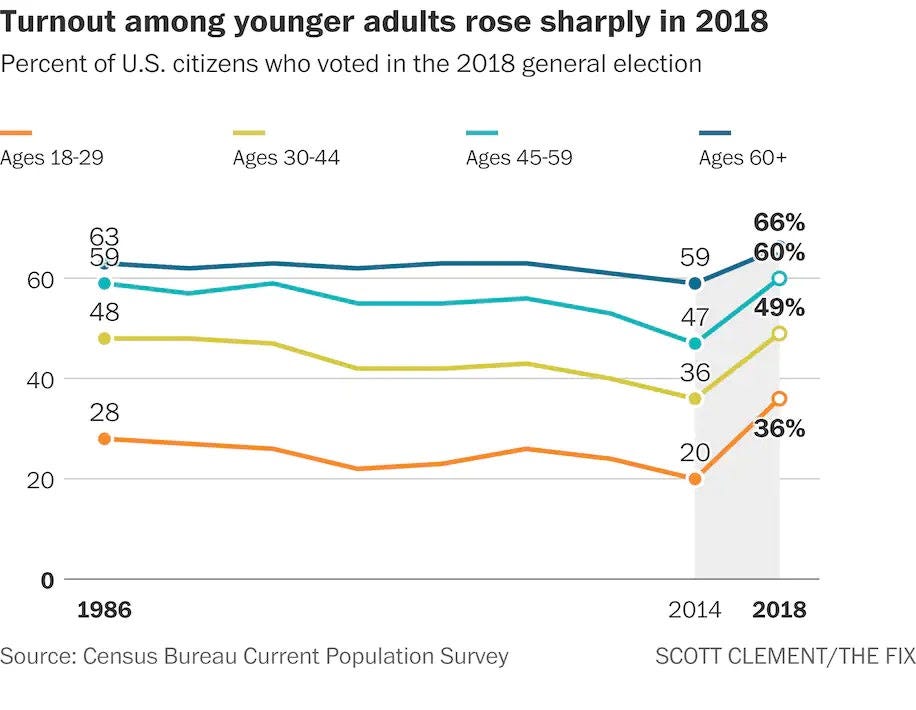
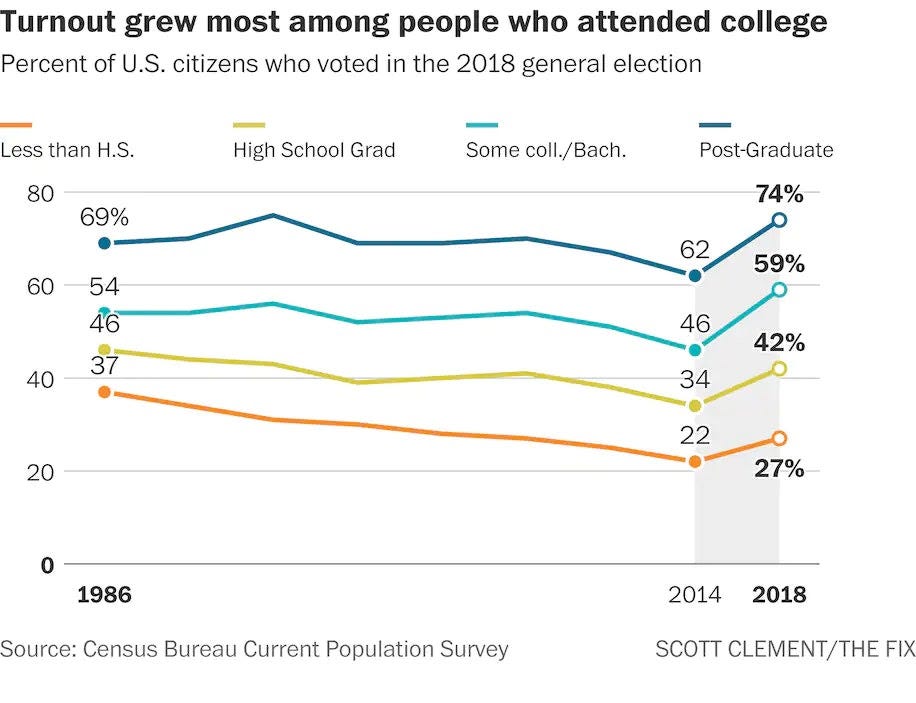
    Midterm elections are all about turnout. Young people and college-educated voters made all the difference in the last midterms in 2018 — giving Democrats control of the House by a wide margin.

    While young people usually don’t pay much attention to midterm elections, a record 36 percent of them voted in 2018, in contrast to 20 percent in 2014.

    Turnout of college-educated voters — another critical voting constituency to the Democratic Party, and also a majority of Independents who vote in midterms — also spiked in the 2018 midterms.

    True, Trump was a driving force for both groups in 2018. But it’s not as if Trump has disappeared. His attempted coup continues to this day. Nor would the Supreme Court’s extraordinary rightward lurch on reproductive rights and the environment have occurred but for Trump’s three Supreme Court appointees.

    It’s also true that Democrats have to cope with a filibuster in the Senate. But they need only fifty votes (plus the Vice President) to carve out exceptions to the filibuster for reproductive rights and for environment. Carve-outs from the filibuster are not uncommon. There have been some 160 of them, including one for confirming Supreme Court nominees (courtesy of Mitch McConnell and Senate Republicans). If Republicans regain control of the Senate, you can bet they’ll carve out exceptions to the filibuster for whatever they want to do. They may abolish the filibuster altogether.

    But can Senate Democrats even muster 50 votes for such carve-outs? Joe Manchin and Kyrstin Sinema have signaled before they they won’t go along.

    Even if Manchin and Sinema were reluctant to agree to such carve-outs before, the situation has changed dramatically now that the Supreme Court has reversed Roe and stopped the Clean Power Plan. If reproductive rights are going to be preserved and the planet protected, Democrats must unite, and Manchin and Sinema must join them. If they won’t, let the nation see.

    Don’t let Republicans off the hook here, either. Alaska’s Lisa Murkowski is up for reelection this fall. She talks a good game about reproductive rights and about the environment. Last February, she and Maine Republican Senator Susan Collins introduced the Reproductive Choice Act, to prevent women’s reproductive choices from being weakened or eliminated. And she co-authored with Joe Manchin an oped in the Washington Post about the importance of ending climate change. Hell, Utah’s Mitt Romney just published a piece in the Atlantic entitled “America is in denial,” warning about climate catastrophe. Okay, Mitt: Unless you’re in total denial that the Supreme Court just gutted the Clean Power Plan, you have to join with Democrats to carve out an exception to the filibuster for the environment and then vote for the Plan.

    It’s time for Democratic lawmakers and anyone else who cares about reproductive rights and the environment to act. Now. At least hold votes and put lawmakers from both chambers on record. Paint a clear contrast ahead of the November midterms. Give voters a reason to turn out.

    You can link to the original substack post below. Consider subscribing to Robert Reich’s letters. I don’t always agree with him. But he is wicked smart and is on the side of justice and an America for everyone.

    Robert Reich
    How Democrats can still protect reproductive rights and the planet
    Listen now (5 min) | I have no patience for all the handwringing by Democratic lawmakers in Washington over the Supreme Court’s regressive decisions on abortion and the climate. “This MAGA, regressive, extremist Supreme Court is intent on setting America back decades, if not centuries,” Senate Majority Leader Chuck Schumer…
    Read more

  • Are these individual shooters just the price of “freedom”?

    Or are they the unwitting tools of the White Supremacists? Keep in mind that white supremacism is now a mainstreamed concept with the Republican Party. A party that is no longer “conservative”. It is the party of fascism. It’s the party that teaches the “Great Replacement Theory”. GRT, apparently is the antidote to being “woke” or “CRT”.

    This is Payton Gendron. 18 years old. He wrote a manifesto based on right wing white supremacist madness and lies. He shot 13 people. 10 are dead. His ideas did not come from a dream or some sudden revelation. He was taught to hate. He was taught to kill.
    This is not an isolated incident. He is not a “lone wolf”. He is part of an online pack of rabid beasts. The greatest threat to our nation is not Russia, it is us.

    TC, my fellow substack writer describes below how we got here. His letter is illuminating and filled with important observations by a terrorism expert, Dr. Juliette Kayyem, a former Assistant Secretary at the Department of Homeland Security and now faculty chair of the homeland security program at Harvard University’s Kennedy School of Government.

    If you want to know how we got here and why Buffalo is just one example of American Fascism, read “That’s Another Fine Mess”. We are at war and the fascists are funded by the Uber Maga rich.

    Thats Another Fine Mess
    STOCHASTIC TERRORISM
    The term “Stochastic Terrorism” has been making the rounds again this past weekend. What does the term “ stochastic terrorism” mean? Stochastic terrorism is officially defined as, “the public demonization of a person or group resulting in the incitement of a violent act, which is statistically probable but whose specifics cannot be predicted…
    Read more